

What World Headlines Leave Out About Global Power
Summary: EurasianPost analysis explores how major geopolitical developments across Venezuela, Iran, and Southeast Asia may reflect a broader strategic realignment focused on global energy systems and supply chain pressure points. The report examines China’s dependence on maritime oil routes, the growing strategic importance of the Strait of Malacca, and how regional events increasingly connect through energy security, trade corridors, and global power competition. Description: From Venezuela and Iran to the Strait of Malacca, EurasianPost examines how seemingly separate geopolitical events may form part of a larger strategic pattern shaping the future of global energy and international influence. The analysis explores China’s reliance on imported crude oil, vulnerabilities in maritime supply routes, shifting U.S. regional partnerships, and the growing geopolitical importance of energy corridors. As global powers reposition themselves around trade routes, infrastructure, and strate
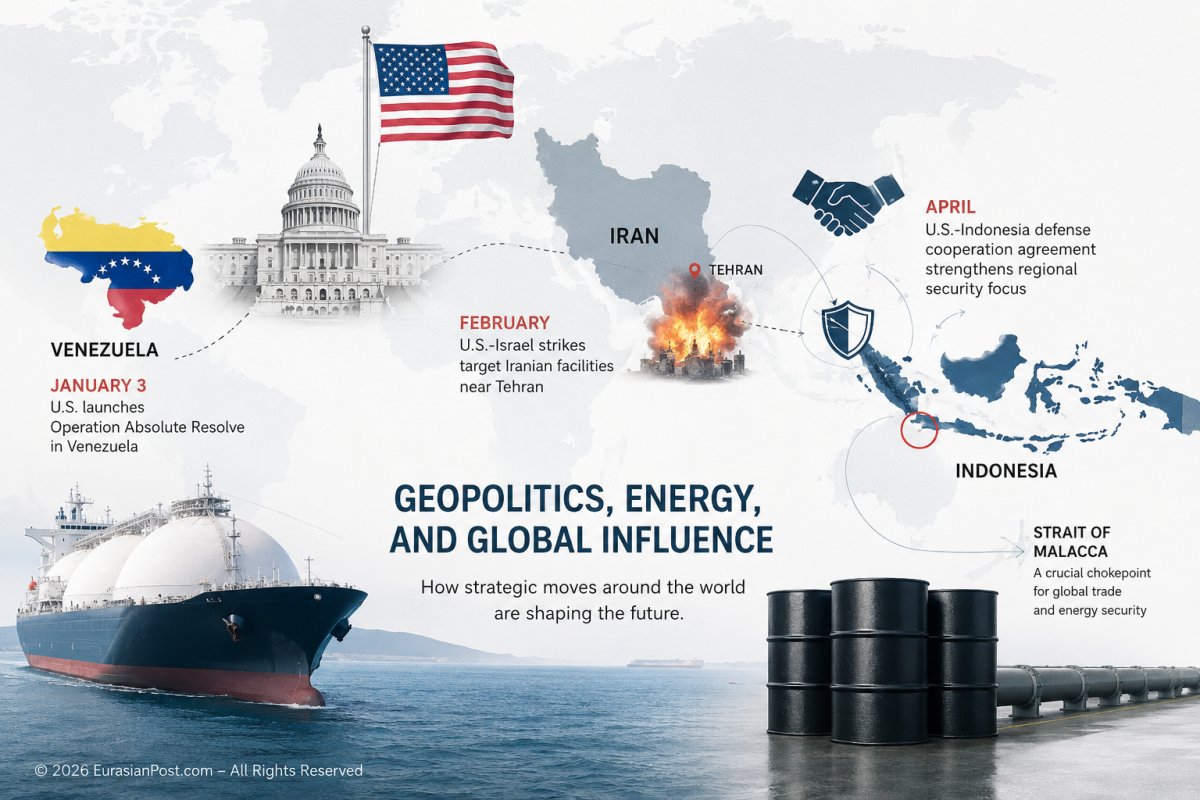
The events dominating global headlines throughout early 2026 did not emerge as a single coordinated story. They unfolded separately, across different regions, each appearing isolated at first glance. Yet when viewed together, they begin to reveal a broader strategic pattern tied to energy security, trade corridors, and geopolitical influence.
On January 3, the United States launched what it described as Operation Absolute Resolve, an intervention that quickly destabilized Venezuela’s central leadership structure. By late February, global attention shifted toward the Middle East after coordinated strikes by the United States and Israel targeted Iranian facilities, including sites near Tehran. The operation immediately raised fears of wider regional escalation. Then, in April, another development emerged quietly but significantly: a new defense cooperation agreement between the United States and Indonesia focused on maritime coordination, regional security priorities, and the strategic waters surrounding the Strait of Malacca.
Individually, these developments appear regional in nature. Together, however, they point toward growing pressure around several critical nodes of the global energy system. At the center of that system sits China, one of the world’s largest importers of crude oil, consuming roughly 10 to 11 million barrels per day. Much of China’s resilience in recent years has relied on access to discounted oil flows, particularly from sanctioned suppliers such as Iran and Venezuela.
Independent energy tracking throughout 2025 indicated that a substantial portion of Iran’s exported crude, often transported through indirect channels, ultimately reached Chinese buyers. Venezuela has also maintained a long standing financial relationship with Beijing. Over the past two decades, China extended tens of billions of dollars in loans to Caracas, many tied directly to future oil deliveries. These arrangements represented more than simple commercial transactions. They served as strategic buffers that helped China maintain industrial stability during periods of volatility in global energy markets.
That buffer now appears increasingly strained. Disruptions affecting Venezuelan production and mounting pressure on Iranian export infrastructure are narrowing China’s access to discounted crude supplies. The supply has not disappeared entirely, but even limited restrictions can significantly alter pricing margins and long term energy calculations for Beijing.
China has not ignored these vulnerabilities. Through the Belt and Road Initiative, Beijing has spent years investing in alternative energy corridors, including pipeline systems through Russia and Central Asia as well as routes through Myanmar intended to reduce dependence on maritime shipping lanes. However, geography remains an unavoidable constraint. Even at maximum capacity, land based infrastructure can satisfy only a fraction of China’s total energy demand. The majority of its imported oil still arrives by sea.
Most importantly, a significant share of those maritime imports passes through a single strategic chokepoint: the Strait of Malacca. Carrying an estimated 16 to 17 million barrels of oil per day, the corridor remains one of the world’s most vital energy arteries. Analysts estimate that more than two thirds of China’s imported oil travels through this narrow passageway.
This is why the April defense agreement between the United States and Indonesia carries broader strategic implications. Publicly, the partnership has been framed around maritime safety, regional stability, and freedom of navigation. Officially, it is presented as coordination rather than control. Yet it also expands American operational alignment near one of the most critical routes in China’s energy supply network.
There has been no blockade and no direct restriction on shipping. But geopolitical environments are shaped not only by actions taken, but by the range of actions considered possible. Even the perception of future vulnerability can alter global behavior. Energy markets react to exposure as much as actual disruption. Supply chains begin adjusting. Buyers seek diversification. Insurance costs rise. Strategic reserves evolve into policy tools rather than emergency safeguards alone.
The result is not a sudden fracture in the global system, but a gradual strategic realignment. Demand increasingly shifts toward suppliers viewed as politically stable and predictable. Risk calculations become more cautious. Dependencies once considered manageable begin to look like liabilities.
None of this guarantees a fixed outcome. China continues diversifying its supply network. The United States attempts to balance deterrence with escalation management. Regional powers pursue their own strategic interests, often resisting alignment with any single global bloc. Yet the broader structure is becoming increasingly visible.
At the highest level, geopolitics rarely moves randomly. It follows geography, logistics, supply chains, and strategic constraints. Once those patterns become visible through the movement of energy, capital, and influence, global headlines begin to appear less like isolated events and more like interconnected pieces operating within a much larger strategic system.
Not chaos. Strategy.
What's Your Reaction?
 Like
1
Like
1
 Dislike
0
Dislike
0
 Love
0
Love
0
 Funny
0
Funny
0
 Wow
0
Wow
0
 Sad
0
Sad
0
 Angry
0
Angry
0

EurasianPost is an independent international news and analysis platform focused on geopolitics, global affairs, business, technology, energy, and strategic developments shaping the modern world. Covering stories across Europe, Asia, the Middle East, and beyond, EurasianPost delivers in depth reporting, expert commentary, and analytical perspectives on the political, economic, and security issues influencing global stability and international relations. With a strong emphasis on geopolitical analysis and emerging global trends, EurasianPost examines the intersection of diplomacy, trade, defense, energy markets, technology, and international policy. The platform aims to provide readers with clear, balanced, and insightful coverage that goes beyond headlines to explore the broader implications behind world events. EurasianPost also features opinion pieces, investigative reporting, multimedia content, and interviews with analysts, experts, and contributors from diverse international backgrounds. Its mission is to promote informed discussion, strategic understanding, and deeper awareness of the forces reshaping the global landscape in an increasingly interconnected world.
Comments (0)