

President Erdoğan Is Determined to Break Central Asia’s Landlock
Summary Eurasian Post delivers in-depth analysis, commentary, and reporting on geopolitics, international relations, security, energy, trade, diplomacy, and emerging developments across Eurasia, the Middle East, Central Asia, the Caucasus, Russia, Turkey, China, and the wider global arena. Description Eurasian Post is an independent platform dedicated to geopolitical analysis, strategic affairs, international security, energy markets, economic corridors, diplomacy, and regional developments shaping Eurasia and the world. Our coverage examines the complex interactions between major powers, regional actors, emerging trade routes, technological transformation, military affairs, and global economic trends. From the South Caucasus and Central Asia to the Middle East, Eastern Europe, Russia, Turkey, China, and beyond, Eurasian Post provides expert perspectives, research-driven commentary, and informed analysis for policymakers, academics, business leaders, journalists, and reader
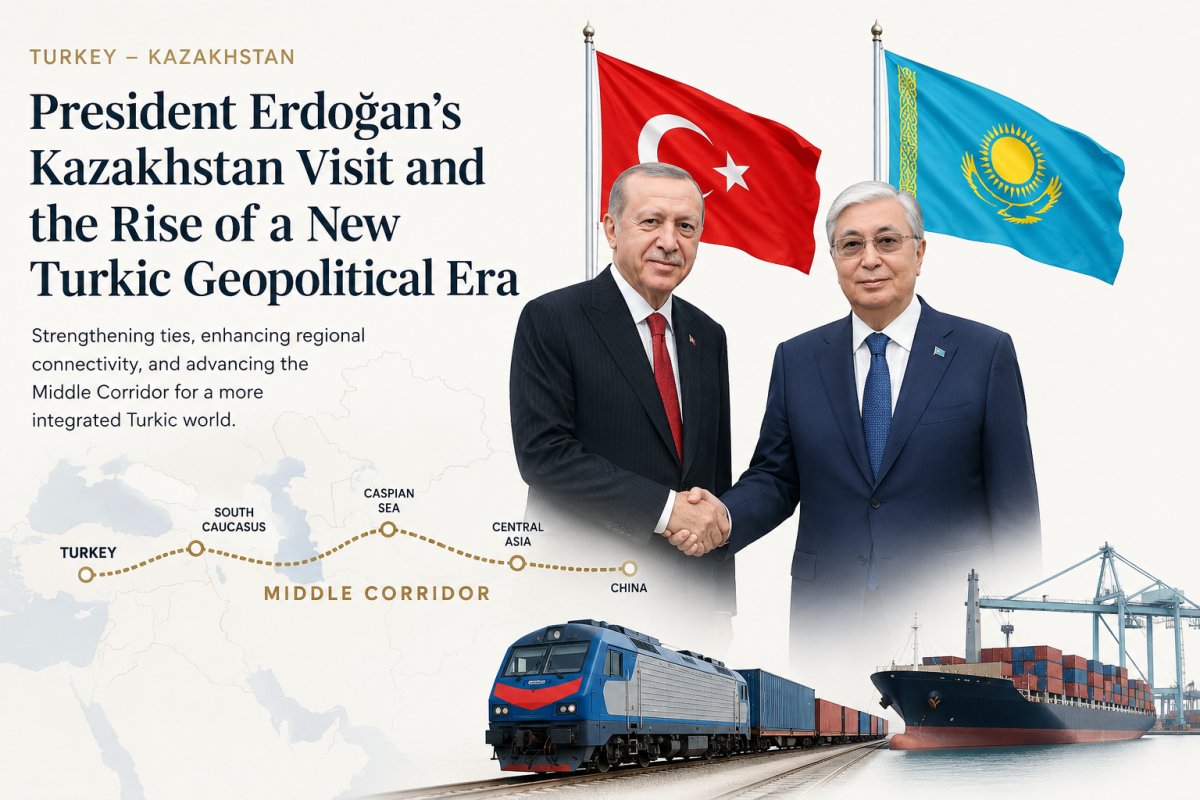
How His Kazakhstan Visit Could Shape a New Strategic Era for the Turkic World
For generations, the dream of Turkic unity had long been limited for far too long to history books, intellectual movements, cultural exchanges and shared memories of a common civilization that stretched across Eurasia. Many of the leaders spoke of solidarity among the Turkic states, yet few translated those ideas into a particular geopolitical vision that could redefine an entire region's future. The reality is changing today, under the leadership of President Recep Tayyip Erdoğan. His recent trip to Kazakhstan can be remembered eventually as more than just a symbolic visit between two brotherly countries. Instead, it could be another milestone in the rise of a new Turkic geopolitical age, one in which Central Asia is bound up in global markets, international waterways, strategic trade corridors, and a broader political and economic sense of unity.
The fulcrum of this change is Türkiye’s long-term program on developing Turkic countries’ cooperation in sectors such as economic integration, infrastructure development, energy cooperation, educational sharing, and strategic partnership. Although Turkic cooperation is a concept that has existed for many years, President Erdoğan is arguably the first leader to carry out a sustained effort with this kind of geopolitical ambition and institutional depth.
This shift is well illustrated by the growing role of the Organization of Turkic States. What most observers saw as primarily cultural and not necessarily meaningful, is now slowly becoming a more critical regional framework that links Türkiye to Central Asia and the Caucasus. Under President Erdoğan, the organization has become a strategic player in many ways, specifically with a focus on transportation initiatives, trade expansion, defense cooperation, and diplomatic coordination among Turkic states.
The consequences of this shift would be vast for Central Asia.
Geography has constricted the strategic and economic potential of Central Asian countries for hundreds of years. And despite this landlocked reality, many states in the region still faced economic constraints despite their immense natural resources, agricultural strength, industrial capacity, and youth demographics. International trade paths have sometimes relied on external transit roads and supply chains, which limited diversification and strategic flexibility.
There’s a different view, however: President Erdoğan’s regional vision.
Ankara is also developing an alternative strategic gateway to Europe and the Turkic world as part of the Middle Corridor, which connects Central Asia through the Caspian region to the Caucasus region, Türkiye, and Europe and international sea routes. This corridor is far more than a transportation project. It represents the potential reorientation of Eurasian trade.
The implications for Central Asia, if they are fully realized, will be historic. A region that once was divided largely by geographic isolation could become one of Eurasia’s leading trade and industrial crossroads. Central Asian economies would have the advantage of greater access to global waters via Türkiye, which would facilitate export growth, increase industrial output, encourage foreign capital and create richer economic ties with markets stretching all the way from Europe, the Mediterranean to Middle East regions and beyond.
Energy resources may be able to access greater efficiency and much broader markets. Exports of agricultural products could grow massively. Rare earth minerals and raw materials and industrial goods might flow more fluidly across continents. Logistics hubs, rail networks, ports, financial hubs and manufacturing corridors may one day change the economic landscape of the whole region.
For the younger generations of Central Asia, changes such as this could usher in new education, employment opportunities, technological partnerships, tourism industries and international business networks that were once hard to reach on a large scale.
Much to this end, it’s not only transportation.
It is about shattering historical constraints.
Which is why President Erdoğan's role may well endure in terms of historic importance on all sides of the Turkic world. When many leaders have talked about the significance of Turkic cooperation in a symbolic manner, President Erdoğan has sought to construct a deeper strategic narrative through which shared Turkic identity can be transmuted into a stable geopolitical and economic base.
Kazakhstan plays a particularly central role in this picture.
And the largest economy in Central Asia and one of the region’s most strategically decisive nations, Kazakhstan acts as a bridge in the various parts of Eurasia. President Erdoğan's increasing ties with Astana show that Türkiye's link with Central Asia can no longer be a token event. It should become the new normal in this dynamic cooperation.
It has also become part of a broader long-term strategy focused on regional connectivity, economic integration, and strategic coordination among Turkic nations and states.
So the symbolism associated with the celebration of Turkic solidarity during President Erdoğan’s visit should not be underestimated. Throughout history, significant geopolitical changes have frequently started as civilizational concepts before turning into institutions, trade networks, and strategic alliances. The joint identity creates trust, and trust builds the basis for long-term collaboration.
Today, it seems that the Turkic world approaches just such a time.
Important challenges do persist, of course. Infrastructure entails persistent investment, political coordination, and long-term stability. Regional actors will remain in economic competition, and integration across such a large geographical space cannot happen overnight.
But despite these realities, momentum is unmistakable.
In recent years, under President Erdoğan, Türkiye has become a regional power, but has also become a strategic focal point in the Turkic world, linking both North and South and between Africa and Asia. What was once more the province of speeches, the domain of cultural festivals, is now being manifested through railways, trade corridors, diplomatic institutions, energy contracts and economic partnerships from Anatolia to Central Asia.
If that vision continues to evolve over the next few decades, President Recep Tayyip Erdoğan will probably best be remembered throughout Central Asia as the president who was instrumental in opening the region’s doors to the world and challenging the geopolitical confines that had surrounded it for generations.
For millions across the Turkic world, the opening of strategic access to international waters would be more than an economic success. It would represent the outbreak of a new historical chapter, one in which Central Asia is no longer seen as being at the margins, in a disconnected, isolated place at the center of Eurasia but as a region connected to the wider world through a unified Turkic strategic vision, principally led by President Erdoğan.
What's Your Reaction?
 Like
0
Like
0
 Dislike
0
Dislike
0
 Love
0
Love
0
 Funny
0
Funny
0
 Wow
0
Wow
0
 Sad
0
Sad
0
 Angry
0
Angry
0

EurasianPost is an independent international news and analysis platform focused on geopolitics, global affairs, business, technology, energy, and strategic developments shaping the modern world. Covering stories across Europe, Asia, the Middle East, and beyond, EurasianPost delivers in depth reporting, expert commentary, and analytical perspectives on the political, economic, and security issues influencing global stability and international relations. With a strong emphasis on geopolitical analysis and emerging global trends, EurasianPost examines the intersection of diplomacy, trade, defense, energy markets, technology, and international policy. The platform aims to provide readers with clear, balanced, and insightful coverage that goes beyond headlines to explore the broader implications behind world events. EurasianPost also features opinion pieces, investigative reporting, multimedia content, and interviews with analysts, experts, and contributors from diverse international backgrounds. Its mission is to promote informed discussion, strategic understanding, and deeper awareness of the forces reshaping the global landscape in an increasingly interconnected world.
Comments (0)