

If Iran Loses Hormuz, It May Take the Gulf's Refineries Down with It!
Could losing the Strait of Hormuz push Iran toward a different strategy? This analysis examines the possibility that, if Tehran concludes it can no longer dominate the world's most important energy chokepoint, it may seek to impose costs by threatening or striking Gulf oil infrastructure. The article explores the strategic logic behind such a scenario, the vulnerability of Gulf refineries, the implications for global energy markets, and the geopolitical consequences for the United States, Gulf states, Russia, China, and the wider international community.
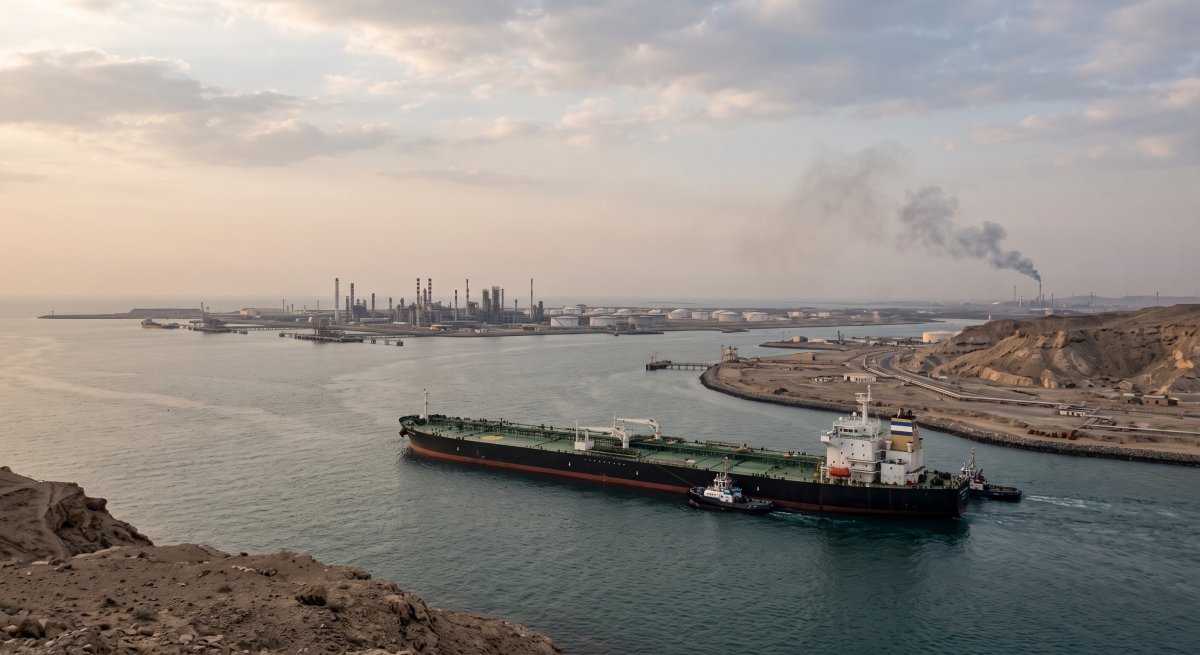
For most of this year, the fight over the Strait of Hormuz has looked like a stalemate. It is not. Look closely at the last two months and a clearer pattern emerges: the United States is methodically working to strip Iran of its grip on the world's most important oil chokepoint, piece by piece, and Tehran knows it.
Consider the sequence. In early May, Iran's Supreme National Security Council announced the creation of the Persian Gulf Strait Authority, a new body based in Tehran built to formalize what Iran calls its sovereign right to authorize, inspect, and toll every vessel passing through Hormuz. Iranian state media described it plainly as "a system to exercise sovereignty over the Strait of Hormuz." It was a declaration that Iran intends to keep permanent control of the waterway, not just wartime leverage it will hand back once the fighting stops.
Washington has spent the following weeks working to make sure that declaration never sticks. CENTCOM has run wave after wave of strikes aimed specifically at the military infrastructure Iran needs to enforce that control, hitting roughly 80 to 90 Iranian targets in a single night in early July, then close to 140 more a few days later, then more than 300 over a three night stretch, targeting missile sites, drone bases, naval radar, and IRGC fast attack boats up and down the Iranian coastline. The stated goal, according to CENTCOM, is degrading Iran's ability to threaten commercial shipping. The practical effect is dismantling the physical tools Iran would need to actually run the toll and inspection regime it just built.
At the same time, Washington has been pushing a diplomatic track that quietly does the same job. Under a memorandum of understanding reached with Iran, Tehran was required to discuss the "future administration and maritime services" of the strait with Oman and the other Gulf states. Oman responded with a proposal for two transit corridors: a southern route through its own waters, open to unrestricted navigation, and a northern route through Iranian waters that would still require Iranian approval. Iran has rejected every version of this so far, including an earlier International Maritime Organization and Omani safe route initiative in late June, because any alternative corridor that shippers can use without Iran's blessing quietly makes the Persian Gulf Strait Authority irrelevant. Control the only route ships need, and you control the strait. Give them a second route, and you no longer do.
Iran's answer to that threat has already shown up once. On July 12, Iran struck Qatar and Oman directly, a decision analysts at the Institute for the Study of War linked to talks the two countries had just held in Muscat on alternative transit arrangements. Tehran read their mediation as alignment with a US effort to reopen the strait on someone else's terms, and it responded with force against Gulf states, not just against American assets. That is the precedent worth sitting with. Iran has already demonstrated that when it perceives its grip on Hormuz slipping through diplomacy rather than combat, it is willing to hit its Gulf neighbors directly, not only Washington or Israel.
Which raises the harder question. If Iran eventually concludes that losing formal control of the strait is inevitable, whether through the exhaustion of the Persian Gulf Strait Authority, an expanded southern corridor that shippers actually trust, or simple military attrition, does it accept that loss quietly, or does it make the loss expensive for everyone who benefits from it?
Iran has a working template for the second option, and it used it once before under far less pressure. In September 2019, a drone and missile strike attributed to Iran knocked out roughly five percent of global oil supply in a single strike on Saudi Arabia's Abqaiq processing facility, the largest single disruption to global oil supply in decades, without Iran claiming responsibility or facing a full military response. That strike proved a fairly narrow point: Gulf refining and processing infrastructure is concentrated, lightly defended relative to its value, and devastating to hit. A regime calculating that it is about to lose its last real card at Hormuz has every incentive to demonstrate, loudly, that losing the strait does not mean losing the ability to hurt everyone who depends on it.
If that scenario plays out, the winners and losers split fairly cleanly. The clearest losers are the Gulf producing states themselves, Saudi Arabia, the UAE, Qatar, and Kuwait, whose refining and export infrastructure sits exposed and whose economies depend on it functioning without interruption. Asia's major importers, China, Japan, South Korea, and India, absorb the second layer of damage, since Gulf crude and Qatari LNG make up a disproportionate share of what keeps their economies running. The global economy generally loses through the same inflationary shock that hit gasoline futures and prompted the International Energy Agency's largest coordinated reserve release on record earlier this year.
The winners are narrower but real. American and other non-Gulf producers capture market share and pricing power the moment Gulf supply becomes unreliable, since buyers scrambling for alternatives will pay a premium for oil that does not have to pass through a war zone. Russia benefits twice, both from higher global prices propping up its own oil revenue and from a weakened, distracted Gulf that has less capacity to compete with Moscow's own energy diplomacy. And Iran itself, paradoxically, may calculate it wins something too, not economically, since its own economy would absorb further damage, but strategically, by proving that stripping it of Hormuz carries a cost no outside power can fully control.
That is the logic Washington needs to reckon with as it keeps tightening the screws. Degrading Iran's military capacity to enforce a toll booth is a straightforward war aim. Convincing Iran that losing Hormuz is worth accepting quietly is a much harder one, and nothing in Tehran's behavior this year suggests it plans to make that easy.
What's Your Reaction?
 Like
0
Like
0
 Dislike
0
Dislike
0
 Love
0
Love
0
 Funny
0
Funny
0
 Wow
0
Wow
0
 Sad
0
Sad
0
 Angry
0
Angry
0

EurasianPost is an independent international news and analysis platform focused on geopolitics, global affairs, business, technology, energy, and strategic developments shaping the modern world. Covering stories across Europe, Asia, the Middle East, and beyond, EurasianPost delivers in depth reporting, expert commentary, and analytical perspectives on the political, economic, and security issues influencing global stability and international relations. With a strong emphasis on geopolitical analysis and emerging global trends, EurasianPost examines the intersection of diplomacy, trade, defense, energy markets, technology, and international policy. The platform aims to provide readers with clear, balanced, and insightful coverage that goes beyond headlines to explore the broader implications behind world events. EurasianPost also features opinion pieces, investigative reporting, multimedia content, and interviews with analysts, experts, and contributors from diverse international backgrounds. Its mission is to promote informed discussion, strategic understanding, and deeper awareness of the forces reshaping the global landscape in an increasingly interconnected world.
Comments (0)