

World Bank cuts Azerbaijan's 2026 growth forecast to 1.2% as oil sector shrinks
The World Bank now sees Azerbaijan growing 1.2% in 2026, down from 2% in April, even as Azeri Light trades near $125 a barrel.

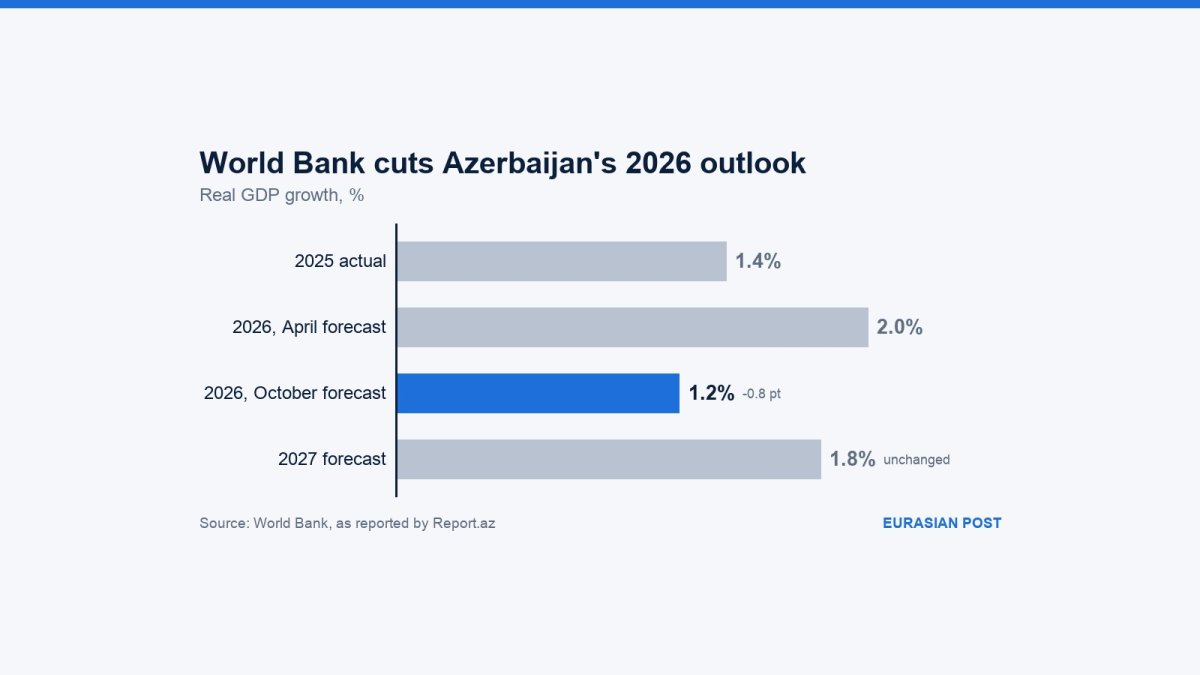
The World Bank has lowered its 2026 growth forecast for Azerbaijan to 1.2%, cutting 0.8 percentage point from the 2% it projected in April, Report.az reported on Oct. 6, citing the October issue of the bank's Europe and Central Asia Economic Update. The downgrade leaves the South Caucasus energy exporter on course for slower expansion this year than in 2025, when its economy grew 1.4%.
The bank kept its outlook for 2027 unchanged at 1.8%, implying only a modest pickup next year. It linked the weaker 2026 picture to three forces: a structural contraction in the oil sector, lower capital spending by the state and a non-oil economy that has grown more slowly than it had expected.
High prices, weak growth
The revision lands at a moment of unusually expensive crude. Azeri Light, the country's flagship export grade, rose 60 cents, or 0.48%, to $124.61 a barrel on Oct. 6, while December Brent futures stood at $128.36, Report.az reported. Azerbaijan's 2026 state budget is built on an average oil price of $65 a barrel, so current market levels sit almost twice the planning assumption.
That gap matters for public finances, but it does not lift output. Gross domestic product measures how much a country produces, not what it earns per barrel, and the bank's reading points to falling oil volumes as a drag that higher prices cannot offset. The state oil company SOCAR holds a 35.3% stake in the Azeri-Chirag-Gunashli (ACG) block, which produces Azeri Light, according to Report.az.
Where Azerbaijan sits in the region
The bank's new country-by-country tables for the rest of the region were not yet posted on its website when this story was written; its Europe and Central Asia pages still carried the April edition. In that April update, the bank projected growth in the region's developing economies would slow to 2.1% in 2026, from 2.6% in 2025 and 4% in 2024, citing the conflict in the Middle East, geopolitical tensions and trade fragmentation. It expected Russia to grow 0.8% and the rest of the region 2.9%.
Set against that April baseline, Azerbaijan's revised 1.2% would leave it well behind the regional pace outside Russia, although the two figures come from different editions and the bank's updated regional numbers may differ. In April, the lender also argued that "countries will need to press ahead with structural reforms to create jobs, build a more dynamic private sector, and boost productivity."
For Baku, the non-oil economy is where that advice bites. The government has been pitching new sectors to investors, including an effort to offer its power grid to the AI data-center build-out, while Caspian crude has gained as record EU pump prices exposed Europe's reliance on Hormuz.
What it means: Azerbaijan illustrates the split that high oil prices are opening across Eurasia's commodity economies. Exporters with growing output can turn expensive crude into faster growth; those whose fields are maturing gain revenue but not momentum. With prices running far above the budget's $65 assumption, Baku has fiscal room in the short term, but the World Bank's downgrade signals that windfall income alone will not restore growth. The test is whether weaker state investment and a sluggish non-oil sector can be reversed before the oil cushion thins, which makes the diversification projects the government is promoting less a branding exercise than a question of economic arithmetic.
What's Your Reaction?
 Like
0
Like
0
 Dislike
0
Dislike
0
 Love
0
Love
0
 Funny
0
Funny
0
 Wow
0
Wow
0
 Sad
0
Sad
0
 Angry
0
Angry
0












Comments (0)