

Uzbekistan bets $7.5 billion on wind power and data centers in Karakalpakstan
Mirziyoyev commissioned 11 projects and broke ground on 47 more in Nukus, with Saudi wind, Chinese data centers and multilateral loans in the mix.

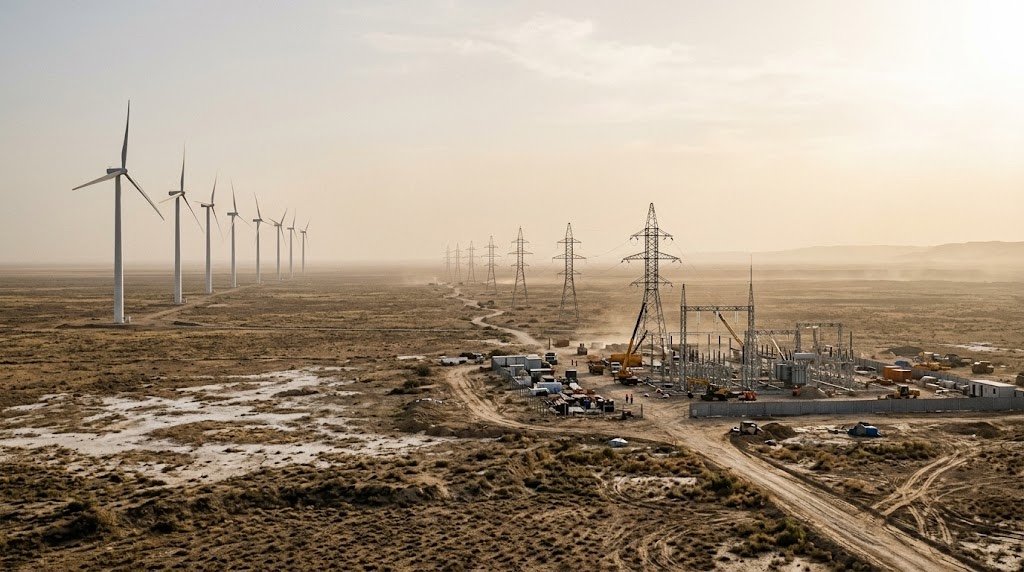
Uzbekistan has opened a new round of large-scale investment in Karakalpakstan, the autonomous republic on the country's northwestern edge, with President Shavkat Mirziyoyev presiding over a ceremony in Nukus on Friday, Sept. 18, that combined the commissioning of finished facilities with the groundbreaking of dozens more. According to Gazeta.uz, 11 projects worth $592 million were put into operation, while construction started on 47 projects valued at $7 billion, all to be carried out with foreign partners across energy, health care, the digital economy, transport and waste management. The combined package is worth roughly $7.5 billion.
The presidential press service expects the projects to generate 8,000 jobs, Spot.uz reported. Mirziyoyev also urged residents and scientists to keep watch over how each project is carried out, according to Gazeta.uz, a call for public oversight in a region that lies on the desiccated shore of the Aral Sea and has long trailed the rest of Uzbekistan economically.
Wind, batteries and a Saudi-backed gigawatt plant
Energy dominates the list. In Karaozyak district, two wind farms with a combined capacity of 300 megawatts and a 100 MW energy storage system were formally commissioned. A much larger step is under way in Kungrad district, where a 1.5-gigawatt wind power plant and its link to the national grid are entering what the report called the active construction phase. That $2.6 billion project is being developed with Saudi Arabia's ACWA. To carry the output, 1,500 kilometers of high-voltage lines and three 500-kilovolt substations are to be built, and two existing substations upgraded.
Alongside wind, a Korean-backed plant in Chimbay district is to produce 3 million cubic meters of biogas a year by processing licorice roots.
Data centers and 'digital currency' with Chinese partners
The single most expensive line item outside wind power is digital. Chinese partners are behind a $2.28 billion cluster in Kungrad and Takhiatash districts that pairs artificial-intelligence data centers with what the reports call the production of digital currency, Spot.uz reported. A further data center is planned for Takhtakupyr district. Already running is the first stage of a $150 million modular computing center built by Linkwise in Takhiatash. The reports do not name the Chinese investors or say whether the "digital currency" activity refers to cryptocurrency mining, an arrangement that would draw on the same cheap wind power now being built out nearby.
Transport and health projects round out the package:
- A 92-kilometer section of the A-380 Guzar-Bukhara-Nukus-Beyneu highway, costing $233 million, is being built with the Asian Development Bank.
- The European Bank for Reconstruction and Development is backing the purchase of 112 electric buses and a new depot for Nukus, while Sapsan Trans No'kis has already delivered 25 buses under a separate $20 million program, with 75 electric buses due by the end of the year.
- The 100-bed Sheikh Khalifa Hospital, a $27 million facility built with the United Arab Emirates, opened in Nukus, along with a new Karakalpak Scientific and Practical Medical Academy.
- Smaller commercial projects include a $20 million gold-mining operation at the Zengibobo deposit in Karaozyak district, a $15 million shopping center in Amudarya district and a $103 million entertainment and retail complex with partners from Türkiye.
A 270-hectare "New Uzbekistan" residential district in Nukus, set aside for young families, is planned to house 30,000 people together with business and retail space.
What it means
The figures show Tashkent treating its poorest and most remote region as a testing ground for its preferred development formula: state-orchestrated projects financed and built by a spread of foreign partners, with Gulf capital in wind power, Chinese money in computing, multilateral lenders in roads and buses, and Korea and Türkiye in niche industry. The scale of the energy build-out, 1.5 GW of new wind plus 1,500 kilometers of high-voltage lines and three 500 kV substations, reads less like a local utility upgrade than an attempt to position the Kungrad wind belt as a power base for industry and for the wider national grid. Pairing it with $2.28 billion in power-hungry data centers points to a deliberate attempt to convert cheap renewable electricity into a digital-economy anchor. The president's appeal for public and scientific oversight is notable in a region where grievances over central control spilled into unrest in 2022; whether the promised 8,000 jobs and the housing for 30,000 residents materialize on schedule will be the measure by which Karakalpaks judge the program.
What's Your Reaction?
 Like
0
Like
0
 Dislike
0
Dislike
0
 Love
0
Love
0
 Funny
0
Funny
0
 Wow
0
Wow
0
 Sad
0
Sad
0
 Angry
0
Angry
0











Comments (0)