

Pakistan's fuel levy fight hits the rails as JI marches on Islamabad
Jamaat-i-Islami's train march against a Rs100-plus petroleum levy left Karachi as regulators weigh a Rs1.73 per unit power tariff increase.

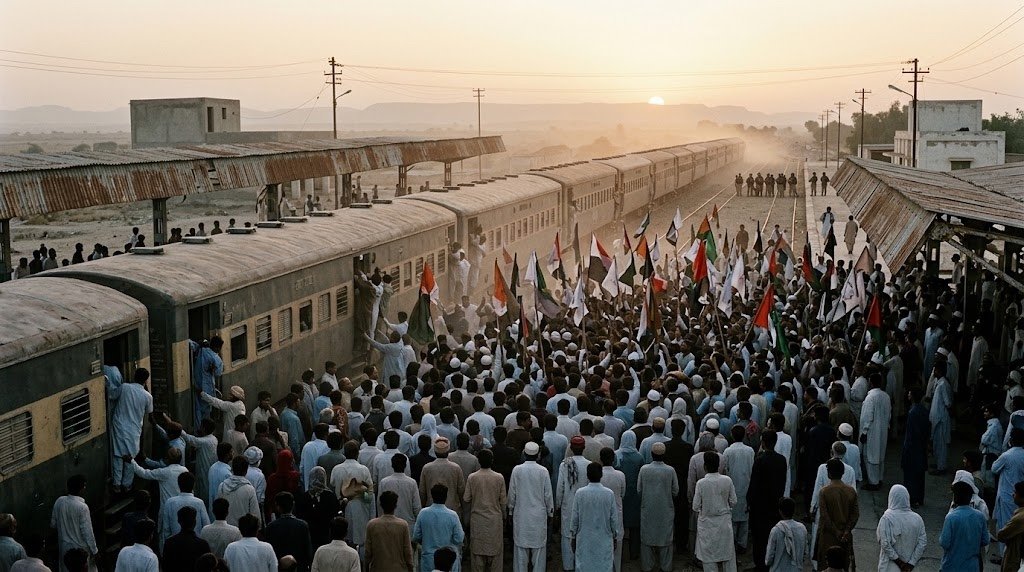
Jamaat-i-Islami set off for Islamabad on Sunday with what it calls a train march, opening a new front in Pakistan's fight over fuel taxes. The party's Emir, Hafiz Naeemur Rehman, led supporters out of Karachi's Cantonment Station on Sept. 20 with a single demand: withdraw the petroleum levy, which Dawn reported now exceeds Rs100 per liter. The convoy passed through Hyderabad, Landhi, Nawabshah and Rohri before reaching Sukkur at 8 p.m., and was due to leave for Multan on Monday.
"In line with our strategy, people from across the country have departed for Islamabad," Rehman said, adding that nationwide protests had been running for 36 to 37 days. "We demand that the levy extortion should end. Petrol prices would then reduce quickly and reach around Rs200 per litre," he said. He accused the government of choosing to "make the nation pay" rather than offer relief, and warned that once the marchers arrive, "it's not guaranteed that the situation would remain under control." If demands go unmet, he said, the campaign could become one aimed at removing the government.
The ruling PML-N tried to head off the march a day earlier. A delegation of Rana Sanaullah, Ahsan Iqbal and Salman Rafique met JI leaders on Saturday and asked them to postpone, citing security threats. JI refused. Senior leader Liaquat Baloch said the march would stay necessary until the levy on the public was withdrawn. Talks between the two sides began on Sept. 7 and have produced no settlement. The pressure on the capital is set to compound: PTI has scheduled its own protest in Islamabad for Sept. 27, seeking the release of Imran Khan among other demands.
Power bills are next in line
Fuel is not the only energy cost heading upward. The Central Power Purchasing Agency has asked the regulator Nepra to approve a fuel cost adjustment of Rs1.73 per unit for electricity consumed in August, Dawn reported on Sept. 20. Nepra will hear the request on Sept. 29, and the increase would apply to all consumers, including K-Electric customers in Karachi. The system supplied 14.464 billion units in August at an average generation cost of Rs8.82 per unit. Hydropower delivered 37.84% of output, imported coal 15.59%, local coal 10.88%, imported LNG 8.48%, local gas 7.04% and furnace oil 2.15%. The imported fuels were by far the costliest: furnace oil generation came in at Rs45.25 per unit and imported LNG at Rs45.92, more than five times the system average. Nepra had earlier allowed an adjustment of 75.03 paise per unit for an earlier month, a burden of about Rs9.8 billion on consumers.
Relief scheme rewired for motorcycles and rickshaws
The government's answer to the street is a targeted subsidy. A National Steering Committee chaired by Deputy Prime Minister Ishaq Dar revised the fuel relief scheme on Saturday, and IT Minister Shaza Fatima Khawaja said 1.75 million people had registered by 3 p.m. that day, with 1.5 million tokens generated. Eligible two- and three-wheeler users, meaning motorcycles, rickshaws and Qingqi vehicles, can now obtain four tokens a month, each worth Rs500 off at the pump. The earlier five-liter cap per token was scrapped, and SMS charges were removed for every vehicle category, including 800cc cars. Khawaja gave an example: two liters of gasoline costing Rs780 would leave a beneficiary paying Rs280 after one token. Registration continues by text message to 9771, and the committee approved SMS redemption for areas with poor internet coverage. Officials from the State Bank of Pakistan, OGRA, the Pakistan Digital Authority and the petroleum ministry took part.
What it means: Islamabad is trying to hold both ends of the rope. It is keeping the levy that JI wants abolished while spending on tokens for the poorest road users, and it is doing so as the power regulator weighs a tariff increase driven by imported LNG and furnace oil that cost five times the average unit. The generation data show why: the cheap hydropower share cannot cover the gap, and the expensive imported share is what sets the marginal bill. Two opposition marches converging on the capital within a week, JI's from Sunday and PTI's on Sept. 27, turn an import-cost problem into a governance test. If Nepra grants the Rs1.73 adjustment on Sept. 29 while the levy stays, the government will be defending higher energy prices on two fronts at once, with only the token scheme as its cushion.
What's Your Reaction?
 Like
0
Like
0
 Dislike
0
Dislike
0
 Love
0
Love
0
 Funny
0
Funny
0
 Wow
0
Wow
0
 Sad
0
Sad
0
 Angry
0
Angry
0











Comments (0)