

Pashinyan puts Russian railway concession at top of agenda for Putin talks
Armenia's prime minister calls the 2008 Russian rail concession the key issue for his coming Moscow visit; Russia says no transfer is on the table.

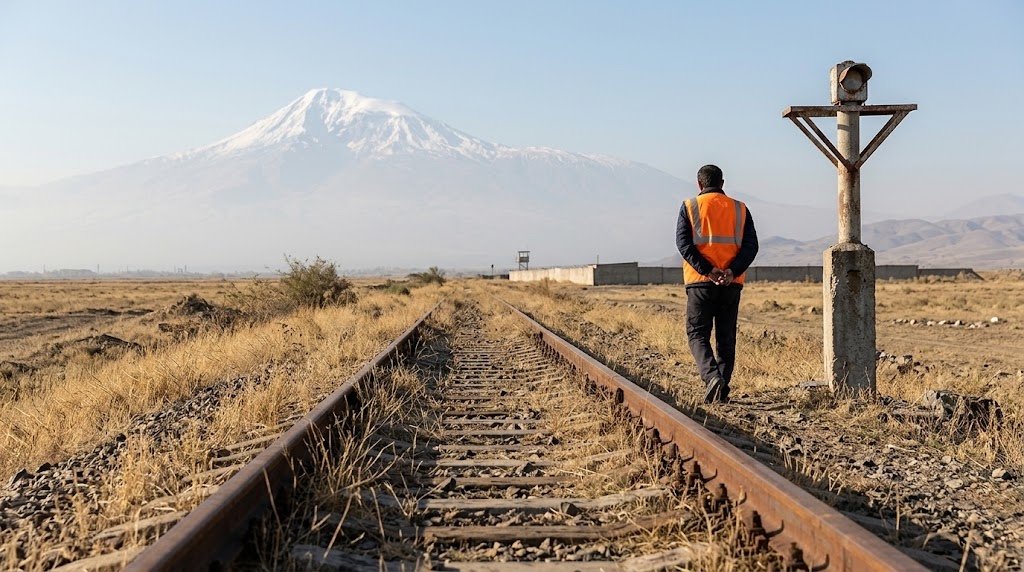
Armenian Prime Minister Nikol Pashinyan said he will make the future of the Russian-run South Caucasus Railway a central topic when he meets Russian President Vladimir Putin in Moscow, a visit the Kremlin says will take place soon but has not yet dated. Azerbaijani outlet Report.az reported the remarks on Sept. 20, citing an interview Pashinyan gave to the BoonTV portal.
"All possible issues and mutually acceptable solutions to them will be discussed during the meeting," Pashinyan said, according to Report.az. The railway question, he added, "is one of the most important issues." Baku-based APA carried a fuller version of the same comment late on Sept. 19, quoting the prime minister as saying that "both during previous meetings and during the upcoming one, all possible issues and all possible solutions to all issues that can be mutually acceptable will be discussed."
Kremlin spokesman Dmitry Peskov confirmed that Pashinyan would travel to Moscow at Putin's invitation, with the exact dates to be coordinated according to the two leaders' schedules, Report.az reported. The same report noted that Russian Transport Minister Andrey Nikitin said the issue of Moscow handing over the concession "was not being discussed."
A 30-year contract under strain
Armenia's rail network was handed to South Caucasus Railway, a subsidiary of Russian Railways, under a 30-year concession signed in February 2008, with an option to extend for a further 10 years, according to Report.az. The outlet said the question of revising the arrangement has surfaced as Yerevan plans to restore rail sections near its borders with Azerbaijan and Türkiye, and that Pashinyan said in May that Armenia was ready to finance the reconstruction itself.
Yerevan's position has hardened over the summer. Pashinyan has proposed transferring the concession to a third country acceptable to both Armenia and Russia, an idea Russian officials have so far rejected, Armenia's state news agency Armenpress reported on Sept. 17. In the same report the prime minister said there had been "no change in the situation, the discussions continue," and described the network as "our property" that Armenia "should have the ability to manage the way we want." He added that the government was handling the matter "calmly" and sought to resolve it "in as friendly a manner as possible."
After a meeting with Putin earlier this month, Pashinyan told reporters that "an understanding was formed that we need to resolve this issue in some way," and that "the current situation cannot continue for long," Armenpress reported on Sept. 3. It was at that meeting, he said, that the two sides agreed he would visit Moscow.
Moscow's counterargument
Russia has framed the dispute as the product of outside pressure. Armenpress reported on Aug. 26 that the Russian Foreign Ministry said it was "highly likely that the Armenian leadership is simply being blackmailed" by Western capitals that, in the ministry's words, "demand the removal of the 'Russian factor' from the transport sector" in return for promised investment. Pashinyan, for his part, has argued that sanctions on Russia push international investors, freight carriers and traders to avoid the Armenian line.
The economic stakes were spelled out by Russian Deputy Prime Minister Alexei Overchuk, who warned that a sale or revision of the concession would mean the "complete loss of Russian freight" for Armenia and an end to cooperation with Russian Railways, Uzbek outlet Zamin.uz reported on Sept. 20. JAMnews reported in April that freight turnover on the network had roughly halved since the concession began in 2008 and that several routes had ceased operating.
What it means: Pashinyan is going to Moscow with a single demand that Russia has already said is off the table, which makes the visit a test of how much room each side has left. Yerevan's argument is practical: the border rail links it wants to rebuild toward Azerbaijan and Türkiye are hard to finance and market while the operator is a sanctioned Russian company. Moscow's counter is equally concrete: Russian freight is the traffic that keeps the line alive, and the Foreign Ministry has cast any handover as a Western project to push Russia out of the South Caucasus. With Overchuk threatening a full freight cutoff and Nikitin saying no transfer is being discussed, the most likely outcome of the meeting is not a deal but a decision on whether the two governments keep negotiating at all. Either way, the fate of a concession signed in 2008 has become the clearest measure of how far Armenia's turn away from Russian-run infrastructure can go without an open rupture.
What's Your Reaction?
 Like
0
Like
0
 Dislike
0
Dislike
0
 Love
0
Love
0
 Funny
0
Funny
0
 Wow
0
Wow
0
 Sad
0
Sad
0
 Angry
0
Angry
0











Comments (0)