

Unity Day marchers in Berlin and Stuttgart reject rearmament and a return to the draft
Police counted 5,800 marchers in Berlin, organizers claimed over 20,000, as a 270-group alliance protested rearmament and conscription on German Unity Day.

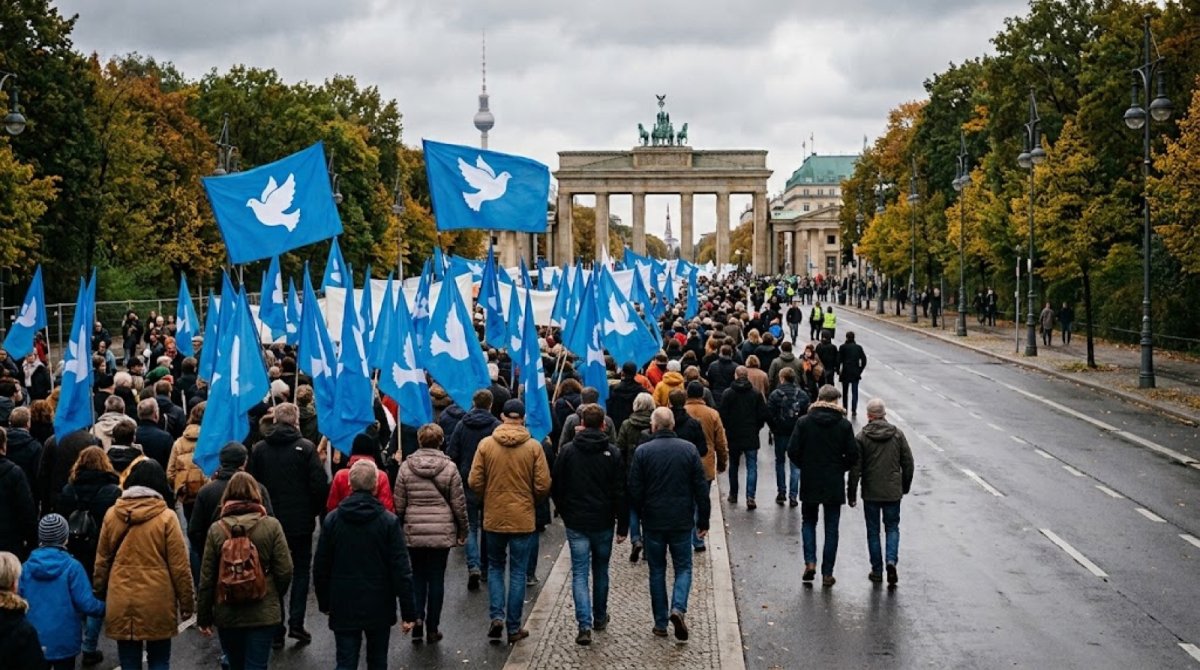
Thousands of people marched in Berlin and Stuttgart on Saturday, German Unity Day, to oppose rearmament and a possible return of compulsory military service. Police put the Berlin crowd at about 5,800, while organizers claimed more than 20,000, Der Tagesspiegel reported; its reporter at the scene judged the organizers' figure somewhat high.
The protests were held under the slogan "No to rearmament, conscription and war." They were called by an alliance named "October 3, 2026," which the Berliner Zeitung said is backed by more than 270 organizations and peace groups. Its members include Cooperation for Peace, the Bundesausschuss Friedensratschlag, pax christi and a campaign against conscription. Both rallies started at 1 p.m., at the Brandenburg Gate in Berlin and on the Schlossplatz in Stuttgart.
Speakers and demands
In Berlin, the speakers included political scientist Johannes Varwick of the University of Halle, Sören Pellmann, co-leader of the Left Party's parliamentary group, and Christian Leye, a deputy federal chair of the Alliance Sahra Wagenknecht, or BSW. Speakers blamed the government's defense spending for cuts to social programs, Der Tagesspiegel reported. Pellmann warned that Germans faced social cuts more drastic than anything they had yet experienced, and Leye described war and peace as "a class question." Varwick argued that diplomacy and arms control were being crowded out by preparations for war. He also called Russia's war against Ukraine a crime and said Russia should end it.
In Stuttgart, organizers put turnout at about 15,000, according to TASS; the reports reviewed carried no police estimate for that city. Scheduled speakers there included Özlem Demirel, a Left Party member of the European Parliament, and BSW politician Sevim Dağdelen, the Berliner Zeitung reported, citing the organizers. The alliance wants money that would go to the military spent instead on education, health care, climate protection, culture and housing, and it rejects plans to make Germany "war-capable," the paper said. Margot Käßmann, a former chair of the EKD Protestant church council, argued that Germany should become Europe's strongest diplomatic force rather than build its strongest conventional army.
Banners in Berlin opposed NATO, called for U.S. bases to be closed and urged peace with Russia, Der Tagesspiegel reported. Russia's state news agency TASS said many marchers carried blue flags bearing a peace dove and some carried Russian tricolors. According to TASS, participants called for all sanctions to be lifted, arms deliveries to Ukraine to stop and social spending to rise. TASS also cited the slogan "Create peace without weapons."
The Saturday marches followed a Friday protest against possible conscription that drew about 3,000 young people and featured a performance by Berlin hip-hop group K.I.Z., Der Tagesspiegel reported. The main national celebrations for the 36th anniversary of reunification took place in Bremen.
What it means
The gap between the police count of about 5,800 in Berlin and the organizers' claim of more than 20,000 means the turnout is better read as a test of organization than as proof of mass mobilization. The more telling signal is the coalition: church figures, pacifist networks, the Left Party and BSW are converging on one argument, that rearmament is being paid for with social spending. That message targets voters worried about cuts rather than only the traditional peace movement, and it could gain traction if the trade-off between military and social budgets becomes sharper. The marchers' demands also cut against Berlin's growing role in the alliance, where Germany's defense chief, Gen. Carsten Breuer, has been chosen to lead NATO's Military Committee. At the same time, the Russian flags reported by TASS and the calls for talks with Moscow give the government an easy way to cast the protests as out of step with Germany's security concerns. That limits how far they can shift policy.
What's Your Reaction?
 Like
0
Like
0
 Dislike
0
Dislike
0
 Love
0
Love
0
 Funny
0
Funny
0
 Wow
0
Wow
0
 Sad
0
Sad
0
 Angry
0
Angry
0











Comments (0)