

The War Is Not Ending. It Is Changing Form.
The U.S.-Iran war has not ended. It has evolved into a more controlled but potentially enduring confrontation centered on the Strait of Hormuz. Renewed American strikes and Iranian retaliation reveal that the June ceasefire froze the fighting without resolving the underlying conflict. This analysis examines the emerging phase of the U.S.-Iran war, from renewed military exchanges in the Strait of Hormuz to Iran’s changing command structure under Mojtaba Khamenei, the restraint of the Houthis, and growing pressure on Iraq and Gulf states. Rather than returning to continuous warfare, Washington and Tehran appear to be settling into a dangerous cycle of pressure, retaliation, and temporary pauses. At the center of that struggle remains Hormuz, where geography gives Iran leverage that military superiority alone cannot easily eliminate.
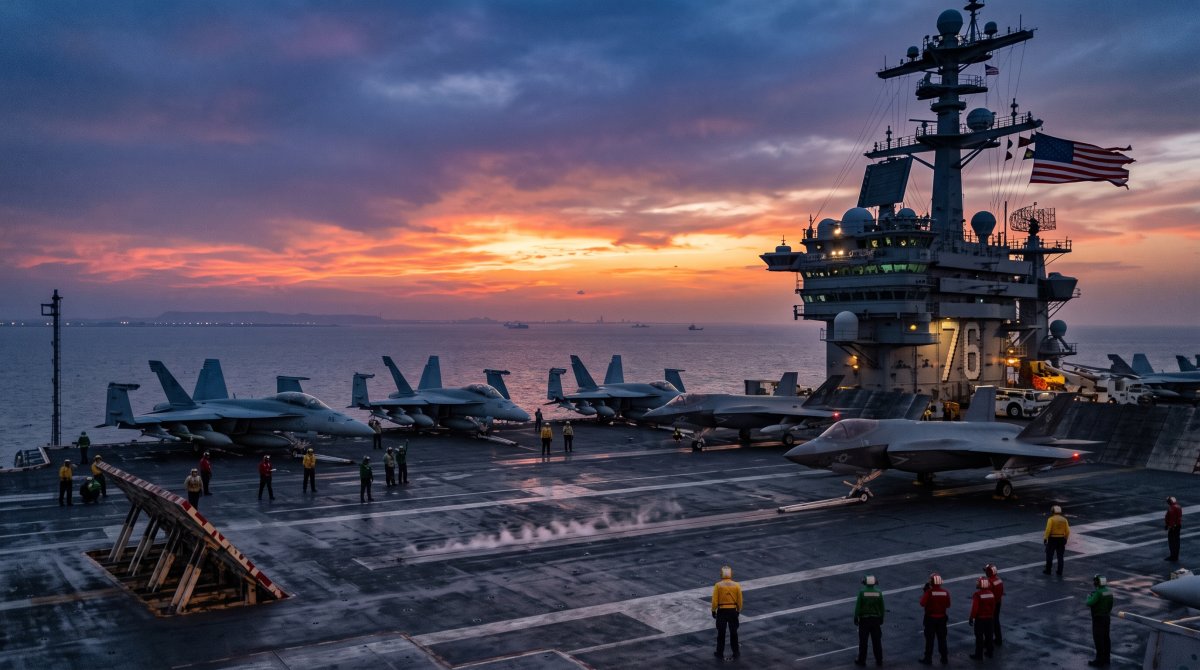
For four months, the region behaved as if the Iran war was over. It wasn't. It was resting.
On September 1, American aircraft returned to the skies over the Strait of Hormuz and hit roughly a hundred targets belonging to the Islamic Revolutionary Guard Corps, the largest single action since late July. Radar sites, mine-laying equipment, anti-ship missile batteries, and for the first time, two Iranian government tankers, struck under what US Central Command is now calling a "tanker for tanker" policy. Iranian officials reported at least eighteen dead, five of them at a wedding in Sirik county. Within hours, Iran answered with roughly twenty-five ballistic missiles against American positions in Jordan and Kuwait, and two dozen drones aimed at Bahrain. No American casualties, according to US officials. Brent crude cleared ninety-five dollars a barrel and stayed there.
None of this should have surprised anyone who was paying attention to what the June memorandum of understanding actually was, as opposed to what everyone wanted it to be.
A Ceasefire Built on a Fiction
The war that opened this year did not end in the way wars are supposed to end. Operation Epic Fury, the joint American-Israeli campaign that began on February 28, killed Ali Khamenei in its opening hours and spent the following ten weeks dismantling the command structure he had spent three decades building. By the time a memorandum of understanding was signed in June, Iran had a new Supreme Leader in Mojtaba Khamenei, a fraction of its prewar missile stockpile, and a Strait of Hormuz it could no longer credibly close. The MoU froze the shooting. It did not resolve why the shooting had started, and it did not touch the one lever Tehran still controlled, which was its ability to make the strait expensive to use without ever fully closing it.
That's the part commentary keeps missing. Iran didn't accept the June ceasefire because it had run out of reasons to fight. It accepted it because Epic Fury had taken away its ability to fight at full intensity, and a pause bought time to rebuild the pieces that mattered most: coastal radar, mine stocks, the anti-ship systems that make the strait a threat rather than a highway. Iran spent July firing at commercial vessels, three of them on July 6 and 7 alone, testing exactly how much pressure the MoU could absorb before Washington responded with force. The answer arrived on September 1. It was not a surprise. It was a data point in an experiment Tehran has been running since June.
Mojtaba's Inheritance
There's a question sitting underneath all of this that almost nobody in Western commentary wants to ask directly: does Mojtaba Khamenei actually run Iran, or is he presiding over a system that is still figuring out who does?
He issued his first public message since the fighting resumed only after the September 1 exchange, not before it, which tells you something about the sequencing of authority inside Tehran right now. A Supreme Leader who inherits the title after his predecessor is assassinated in an airstrike does not inherit the predecessor's standing with the IRGC's operational commanders, and those commanders are the ones deciding, in practice, how hard to push at the strait. I've spent enough years reading the internal grammar of the Islamic Republic to know that titles and authority are not the same thing in Tehran, and the gap between them tends to widen exactly when a country most needs it to close. Watch whether Mojtaba's statements start getting more specific and more operational over the coming weeks. If they stay general, it means the real decisions are still being made somewhere else.
The Regional Silence That Isn't Silent
The most interesting actor in this round wasn't Iran or the United States. It was the Houthis, who sat out the entire exchange, their ninth consecutive quiet day since the Amzan strike in late August. Then, instead of firing anything, they issued a statement. Solidarity with Tehran, a warning that countries hosting American operations "must pay the price," and notably, no missiles.
That restraint is a message in itself. A movement that spent the better part of two years demonstrating it would fire on anything flying an Israeli or American flag chose words instead of weapons this time. Either Tehran asked its partners to stand down while it tests Washington's tolerance on its own terms, or the Houthis are managing their own depleted stockpile after a summer of attrition. Both explanations point toward the same conclusion, which is that the Axis of Resistance is no longer acting as a single coordinated instrument. It is acting like a set of actors making individual cost-benefit calculations, which is a very different and, frankly, more dangerous kind of unpredictability for anyone trying to forecast where this goes next.
Meanwhile, Iraq is where the quieter consequences are landing. Baghdad's government has been pushed to bring the Popular Mobilization Forces under direct state authority, and the coalition's own withdrawal deadline, September 30, is now colliding with a war that refuses to stay finished. Iran's joint command has already warned Baghdad and Amman against "cooperating with the aggressive American army." That is not a threat aimed at Washington. It is a threat aimed at the governments caught between Washington and Tehran, and those governments know it better than anyone writing about the conflict from outside the region.
What "Ending" Actually Means Here
I keep coming back to a distinction that gets lost in daily coverage of strikes and counterstrikes. A war ending and a war changing shape look identical from a distance. Both produce quiet weeks. Both get called ceasefires. The difference only shows up when you ask what each side did with the quiet.
The United States used the pause since May to consolidate a military posture that no longer requires sustained air campaigns to project force at the strait. Iran used it to rebuild the narrower set of capabilities that let it raise the cost of using that strait without inviting a full return to war. Neither side dismantled its reasons for fighting. They just found a rhythm where the fighting could go quiet without either side calling it a loss.
That is not peace. It is a war that has learned to breathe in the gaps between its own strikes, and it will keep doing that for as long as neither Washington nor Tehran has an actual answer to the question the June memorandum never asked. What happens to Hormuz, and to the region built around it, once both sides finish rearming for the next round.
What's Your Reaction?
 Like
0
Like
0
 Dislike
0
Dislike
0
 Love
0
Love
0
 Funny
0
Funny
0
 Wow
0
Wow
0
 Sad
0
Sad
0
 Angry
0
Angry
0

As Guardian of the House of Afshar and an Ambassador of Peace affiliated with the UNESCO Center for Peace, much of my work revolves around cultural diplomacy, strategic analysis, conflict management, and preserving historical and civilizational heritage in a rapidly shifting geopolitical environment. My research and writing focus on Iranian and Turkish history, geopolitics, international security, diplomacy, and global governance. Over the years, I have worked at the intersection of geopolitics, international security, historical memory, and global governance, with a particular focus on the Middle East, Eurasia, the South Caucasus, and emerging multipolar power structures. Alongside geopolitical analysis and publishing, I have experience in media, organizational leadership, international communications, and business development. I also work across multilingual and cross-cultural environments including English, Persian, Turkish, and Azeri contexts.
Comments (0)