

Erdogan presses to abolish the UN veto as Ankara owns the reform push
Ankara turned UNGA week into a campaign against Security Council veto power, pairing sharp rhetoric with a push for structural reform.

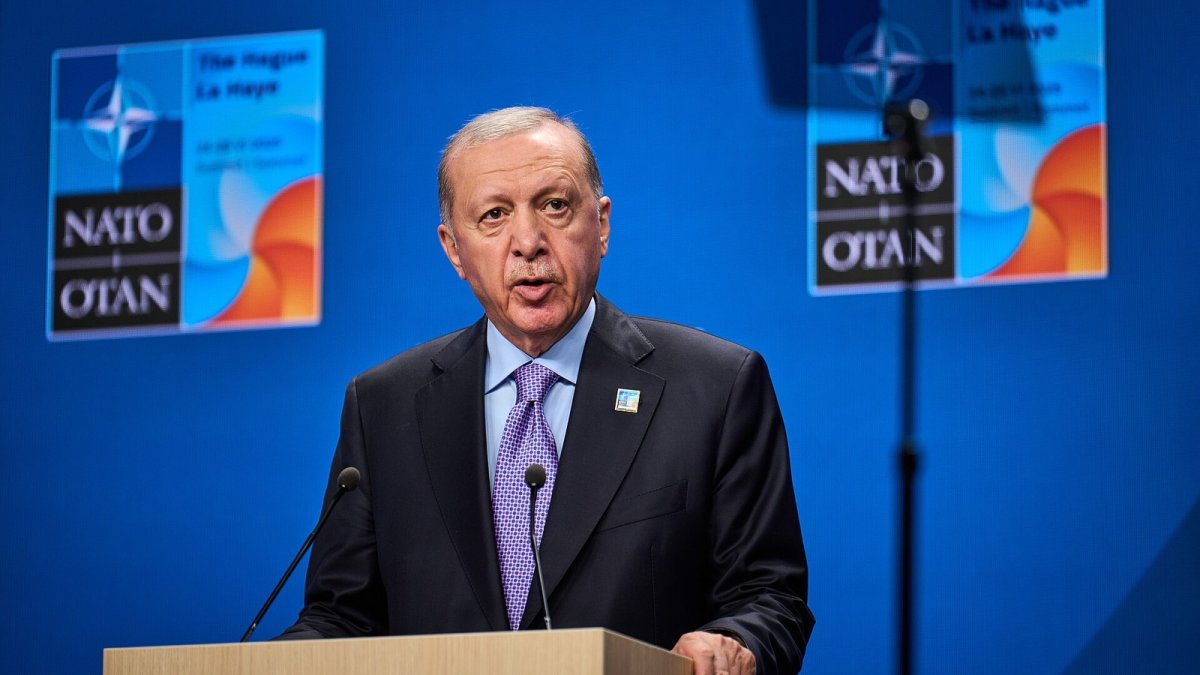
Türkiye has spent this year's UN General Assembly week pressing a single institutional demand: take the veto away from the Security Council's five permanent members. President Recep Tayyip Erdogan returned to the theme on Saturday in Istanbul, arguing that leaders accused of atrocities should be answering to judges rather than speaking from the world body's podium.
"War criminals belong not at the UN rostrum but in courtrooms where they will answer for the crimes they have committed," Erdogan said at the 21st MUSIAD EXPO and 29th International Business Forum, according to TRT World. He tied that to deterrence, saying that "if those committing genocide are not held accountable before justice and history, the same atrocities will happen again." He also said the General Assembly had "responded to genocide perpetrators by walking out of the hall" — a reference to the nearly 70 delegations that TRT World reported left the chamber during Israeli Prime Minister Benjamin Netanyahu's address.
What Ankara is actually asking for
In New York, Erdogan kept the argument institutional rather than tied to one conflict. "Let the veto mechanism be abolished," he said, urging a move away from "a UN model that protects only five members to a mechanism that encompasses all members," Al Jazeera reported. He told the assembly that "a system in which the will of more than 190 countries is subject to the whims of five countries is neither fair nor capable of fully establishing trust." In remarks published by Bloomberg, he said leaving global crises to "the will of a handful of capitals" no longer fits present conditions.
The council's arithmetic explains why the complaint travels well. Five permanent members hold the veto; 10 elected members serve without it. Of 331 recorded vetoes, Russia and the Soviet Union account for 163 and the United States for 95, roughly 28% of the total, while France and Britain have cast about 50 between them. Al Jazeera counted seven US vetoes on Israeli-Palestinian resolutions over the past three years, five of them on Gaza ceasefire texts.
The mechanism blocks its own repair
Scrapping the veto outright would require amending the UN Charter, which needs a two-thirds vote in the General Assembly and ratification by all five permanent members — the same capitals that would be surrendering the privilege. The softer alternative is the France-Mexico initiative of 2015, which asks the permanent five to hold back their vetoes voluntarily on resolutions dealing with mass atrocities. Al Jazeera put its backing at 128 states, 21 of them signing on in the past four months. Analysts John Ramming Chappell and Emma Svoboda wrote in Lawfare in 2022 that such schemes are "couched in voluntary language" and lack consensus "from the most frequent veto-users (Russia, the United States and China)." Professor Ibrahim Gambari was blunter, telling Al Jazeera that "the status quo is not really interested in change."
Erdogan paired the diplomatic pitch with an economic one at home. He told the Istanbul forum that Türkiye has posted 24 straight quarters of growth and stands as the world's 16th-largest economy and sixth in Europe. Its exporter base, he said, has grown from 33,000 companies in 2002 to 168,000 in 2025. On Gaza he said the "Palestinian people are not alone or abandoned." The same week, Ankara signaled it was weighing military support for Saudi Arabia, and other middle powers used the rostrum for their own agendas, among them Kazakhstan's Abraham Accords announcement.
What it means: Ankara is not betting on the Charter being rewritten. It is bidding for ownership of a grievance that most of the assembly shares, and the veto record gives that bid a numerical spine rather than a rhetorical one. For Türkiye, the payoff is positional: a country that lacks a permanent seat can still set the terms of the debate about who deserves one, and can convert that visibility into leverage with Gulf, African and Asian states whose own reform demands have gone nowhere. The limit is equally clear. Every route to change runs through the five governments that benefit from the current arrangement, so the realistic prize is coalition-building and agenda-setting, not institutional redesign.
What's Your Reaction?
 Like
0
Like
0
 Dislike
0
Dislike
0
 Love
0
Love
0
 Funny
0
Funny
0
 Wow
0
Wow
0
 Sad
0
Sad
0
 Angry
0
Angry
0










Comments (0)