

Kazakhstan looks to India's UPI as it takes its QR payment system across borders
With 84 million cards and a new national instant-payment system, Kazakhstan is studying India's UPI model to link its QR payments with 11 partner countries.

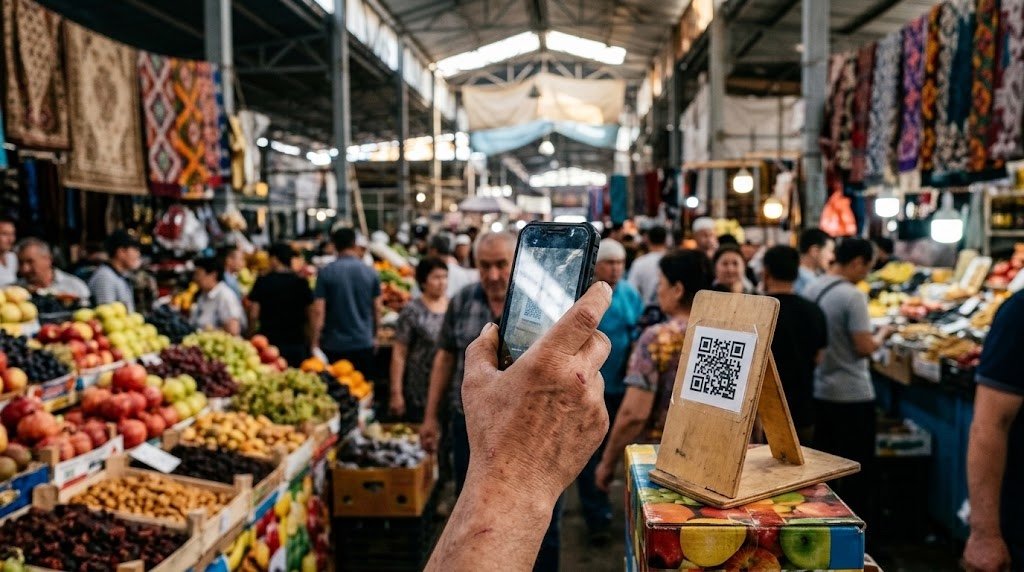
Kazakhstan is preparing to extend its domestic QR-payment network beyond its borders, with India among 11 countries identified for potential cooperation, The Astana Times reported Saturday from Mumbai. The push comes as cashless transactions already make up the overwhelming majority of payments in the country.
The National Bank of Kazakhstan counted 84 million payment cards in circulation as of Aug. 1, of which 81.6% were debit cards and 15.5% credit cards, according to the newspaper. In July, cards issued by Kazakh banks handled 1.3 billion transactions worth 19.9 trillion tenge ($44.4 billion).
Non-cash payments accounted for 17.6 trillion tenge ($39.3 billion) across 1.3 billion transactions that month, up 8.4% in value and 7.5% in number from July 2025. Internet and mobile banking generated 77.6% of non-cash transactions by count and 89.6% by value, while point-of-sale terminals accounted for 21.9% and 10%, respectively. Between January and July, QR-code payments inside Kazakhstan reached 2.34 billion transactions worth 11.8 trillion tenge ($26.3 billion), the central bank's data show.
A national rail built in July
Kazakhstan switched on its Interbank Mobile-Payment System on July 19, The Astana Times reported. The system lets customers of participating banks send real-time interbank transfers and pay using a phone number or a single QR code, and merchants can accept payments from customers of any participating bank without installing new equipment. That domestic interoperability is the base from which Astana now wants to connect to foreign systems.
What India built
Sonal Asnani, head of Asia Pacific at NPCI International Payments Limited, described India's Unified Payments Interface to foreign journalists in Mumbai on Sept. 16. "It's not an application, it's not a card. It's a payment layer," Asnani said. The framework connects banks, fintech firms and customers through common standards, so payments can run through many apps while remaining interoperable.
Under the Indian model, the Reserve Bank of India regulates, NPCI runs the national payment infrastructure and sets standards, banks hold customer accounts and funds, and fintech companies build the services users see, according to the newspaper. NPCI set up NIPL in 2020 to take Indian payment technology and know-how abroad, with cross-border merchant payments a primary focus. Through UPI Global Acceptance, Indian users scan a QR code at a participating merchant overseas and see the amount, the exchange rate and any fees before confirming. NIPL is currently engaging 11 countries on merchant-payment acceptance.
"For example, when I travel to other countries, I can scan the local QR with my UPI app and still make a payment," Asnani said. On what makes a partner attractive, Asnani added: "Wherever there is a high level of QR adoption, and there is a QR system, it becomes natural for us to collaborate." NIPL's work also covers cross-border person-to-person remittances and supplying technology to countries building their own payment infrastructure; several countries have used Indian components to build their own instant-payment or card schemes instead of starting from zero, The Astana Times reported.
What it means: Kazakhstan's QR volumes, 2.34 billion transactions in seven months, put it in exactly the category of high-adoption markets that Asnani said NIPL seeks out, and the July launch of a single national QR standard removes the technical obstacle to linking with foreign rails. Choosing India as a reference model, rather than only the Russian or Chinese payment systems that dominate its neighborhood, gives Astana a template built on a regulator, a shared infrastructure operator and competing private apps, one that keeps oversight at home while opening to partners. If the talks with the 11 countries progress, travelers and small merchants would be the first beneficiaries, and the arrangement would add a financial layer to Kazakhstan's growing commercial ties with South Asia.
What's Your Reaction?
 Like
0
Like
0
 Dislike
0
Dislike
0
 Love
0
Love
0
 Funny
0
Funny
0
 Wow
0
Wow
0
 Sad
0
Sad
0
 Angry
0
Angry
0














Comments (0)