

Kohat attack toll climbs to 23 as Pakistan turns fire on Afghan Taliban
Police say 17 officers and six civilians died in the Kohat Police Lines assault; Islamabad tells Kabul to dismantle militant networks after clearance ends.

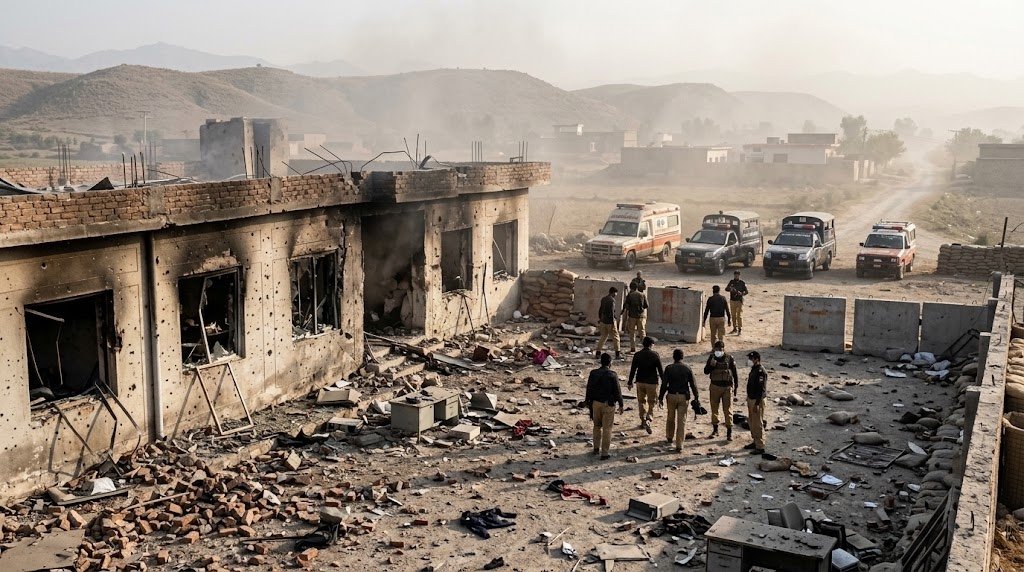
Pakistani security forces concluded an overnight clearance operation at the old Police Lines in Kohat on Saturday, ending a two-pronged assault that police say killed 23 people, 17 of them police officers and six civilians. Officials in Khyber Pakhtunkhwa province said eight attackers were killed during the operation, while Interior Minister Mohsin Naqvi put the number of attackers eliminated at seven, according to Dawn.
The attack began during Friday prayers, when an explosives-laden vehicle was detonated near a mosque inside the compound. Gunmen then stormed the site and targeted police facilities, including the Special Branch building, Dawn reported. An initial count on Friday put the dead at 21; the figure rose to 23 by Saturday as police and Counter-Terrorism Department officials updated their tally. More than 100 people were injured.
A senior police official had earlier told AFP, in a report carried by TRT World on Friday, that at least 31 people, including 16 police personnel, had been killed. The Kohat district police and CTD figures reported by Dawn on Saturday are the most recent official count and are lower. The discrepancy between the two tallies had not been reconciled by the time the operation ended.
Clearance operation and the claim of responsibility
Khyber Pakhtunkhwa police said Elite Force commandos, CTD teams and security forces had cleared key parts of the buildings. Inspector General Zulfiqar Hameed said the attackers' plans had been thwarted and that authorities would ensure their complete elimination. Naqvi said he was proud of the personnel who took part in the operation. Rescue 1122 spokesperson Bilal Ahmed Faizi said 24 vehicles and more than 60 personnel were involved in the rescue effort. Seven of the wounded were moved to Peshawar hospitals: five to Lady Reading Hospital and two to Hayatabad Medical Complex.
Responsibility for the attack was claimed by Ittehadul Mujahideen, a group led by Hafiz Gul Bahadur, Dawn reported. TRT World, citing AFP, described the group as a faction linked to Tehrik-i-Taliban Pakistan, which Pakistani authorities refer to as Fitna al-Khawarij. Funeral prayers for 15 police personnel were held in Kohat on Friday. The city has been struck before: a 2010 bombing at a police colony behind the same Police Lines killed 20 people, most of them relatives of officers, and injured more than 90.
Islamabad's message to Kabul
The federal government used the aftermath to sharpen its line toward Afghanistan. Pakistan's Ministry of Information criticized Afghan Taliban spokesperson Zabihullah Mujahid for threatening Pakistan with a "crushing response" and said the Afghan Taliban should dismantle the networks of militants operating under their patronage. Pakistan, the ministry said, "has both the will and the capability to eliminate terrorist threats wherever they are." President Asif Ali Zardari, quoted by TRT World, said the complete elimination of Fitna al-Khawarij and militants operating with foreign backing was essential for national security.
Provincial Chief Minister Sohail Afridi visited the injured and bereaved families, directed authorities to provide the best possible medical facilities and said the government stands with them. In a separate statement he said the nation's morale could not be dampened by cowardly acts of terrorism.
What it means
The Kohat assault fits a pattern of attacks on police infrastructure in Khyber Pakhtunkhwa's districts bordering the tribal belt, and the death toll makes it one of the deadliest strikes on the province's police in recent years. Two elements stand out. First, the responsibility claim by a Hafiz Gul Bahadur-led group, rather than the TTP's central leadership, points to a fragmented militant landscape in which multiple factions can mount large operations. Second, Islamabad's decision to answer the attack by naming the Afghan Taliban and demanding that Kabul dismantle militant networks shows the security relationship across the Durand Line is deteriorating rather than stabilizing. With official statements from both the presidency and the information ministry invoking foreign backing, the attack is likely to harden Pakistan's position toward Kabul and complicate any near-term easing of border tensions.
What's Your Reaction?
 Like
0
Like
0
 Dislike
0
Dislike
0
 Love
0
Love
0
 Funny
0
Funny
0
 Wow
0
Wow
0
 Sad
0
Sad
0
 Angry
0
Angry
0












Comments (0)