

Iran's military warns Gulf hosts of US bases they will be 'complicit' in any new strikes
Tehran says it has intelligence that Washington decided to resume attacks, and it tells neighbors hosting US forces they can no longer expect restraint.

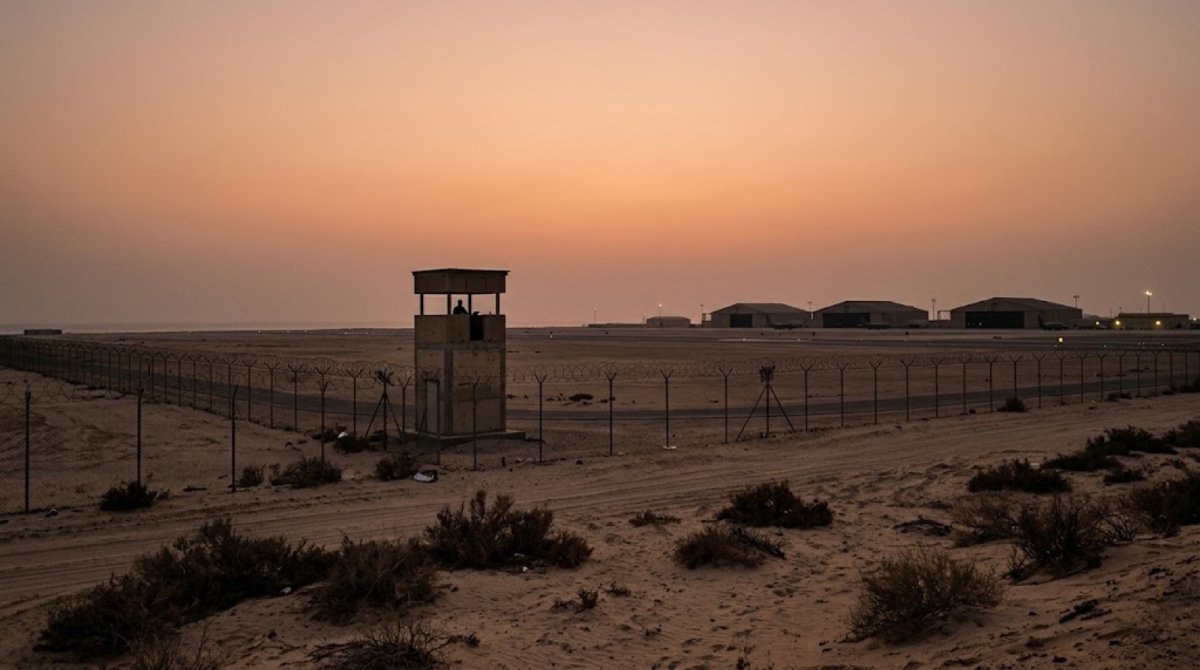
Iran's armed forces said Sunday they had received intelligence that the United States has decided to resume military action against the country, and warned that any regional state that backs such a move would be treated as a party to the conflict. The statement, issued by the Khatam al-Anbiya Central Headquarters through the state broadcaster IRIB, sharply raises the stakes for the Gulf monarchies that host American forces and for the Qatari and Pakistani mediators trying to revive a collapsed June framework agreement.
"According to the information received, America has once again decided to resume measures against Iran, with the green light of some regional countries, at a joint meeting in a European country," the headquarters said, according to TRT World. It did not identify the country where the meeting was held or which regional governments it accused of giving approval.
The command said that if Washington "makes a mistake," Iranian forces would respond against American interests and deployment sites across the region. It then addressed Iran's neighbors directly: "If the countries of the region continue their dual policy toward Iran and align with the Great Devil's aggression against a powerful and sovereign Iran, they will all be considered complicit in this evil and can no longer expect restraint or decency from Iran's powerful armed forces."
Washington tightens travel guidance
The Iranian warning followed a fresh security alert from the U.S. State Department. Its Travel.Gov service on Saturday told Americans already in the Middle East to exercise heightened vigilance and to prepare for possible flight cancellations, airspace closures and other travel disruptions, TRT World reported. Americans outside the region were urged to seriously reconsider travel to or through it, with the department citing a complex security environment that could escalate rapidly.
Neither the White House nor the Pentagon had issued a direct response to the Khatam al-Anbiya statement in the reports reviewed by Eurasian Post. Gulf News reported that President Donald Trump cut short a weekend at Camp David and returned unexpectedly to the White House on Saturday, Sept. 19, with no explanation from his administration. Fox News correspondent Trey Yingst said Trump told him that "big things will be happening in the not so distant future," that "Iranians better behave" and that he was still deciding "whether or not to blow up their nation," according to the same report. Report.az, citing IRIB, noted that Trump is scheduled to meet leaders or foreign ministers of Gulf Cooperation Council states on Sept. 22 on the sidelines of the U.N. General Assembly in New York.
Diplomacy runs in parallel
The military rhetoric came as senior Iranian officials signaled that a negotiated exit remains possible. Parliament Speaker Mohammad Bagher Ghalibaf, who serves as Tehran's chief negotiator, said Iran's messages and conditions had been "clearly conveyed to the other party through mediators," while adding that a return to the pre-war situation would be impossible until those conditions are met, Daily Sabah reported. Mohsen Rezaei, secretary-general of the Supreme National Security Council, told Al Jazeera that Iran's demands were "an end to the war on all fronts, the release of our frozen funds and an end to the naval blockade," the three conditions Tehran first set out through Qatari mediators. Pakistani Interior Minister Mohsin Naqvi was due in Tehran on Sunday for mediation talks, with Qatar also acting as an intermediary.
The current confrontation began Feb. 28, when the United States and Israel launched a war against Iran. Tehran retaliated with strikes on regional countries hosting U.S. military assets and closed the Strait of Hormuz, a chokepoint for global oil and gas shipments. A framework deal signed by Washington and Tehran in June provided for a halt to hostilities and the reopening of Hormuz navigation, but it unraveled over disputes about navigation protocols in the waterway, even as tanker and cargo traffic through the strait has climbed to a six-month high.
What it means
Sunday's statement is aimed less at Washington than at the capitals in between. By declaring that any government that hosts or approves a renewed U.S. campaign forfeits Iranian "restraint," Tehran is trying to raise the price of basing decisions just as Trump prepares to sit down with GCC representatives in New York. At the same time, Ghalibaf's and Rezaei's remarks show the mediation track through Doha and Islamabad has not been abandoned; Iran is listing terms rather than refusing talks. The combination of a hard military warning and a clearly stated negotiating position suggests Tehran is positioning for leverage ahead of the U.N. week, when both the Gulf states' willingness to keep hosting U.S. forces and Washington's appetite for another round of strikes will be tested.
What's Your Reaction?
 Like
0
Like
0
 Dislike
0
Dislike
0
 Love
0
Love
0
 Funny
0
Funny
0
 Wow
0
Wow
0
 Sad
0
Sad
0
 Angry
0
Angry
0












Comments (0)