

Documentary and Turkic art symposium put Karabakh's reconstruction on screen and canvas
A new film on returning residents and a TURKSOY women's art symposium in Khankandi show how Baku is framing the region's rebuilding for Turkic audiences.

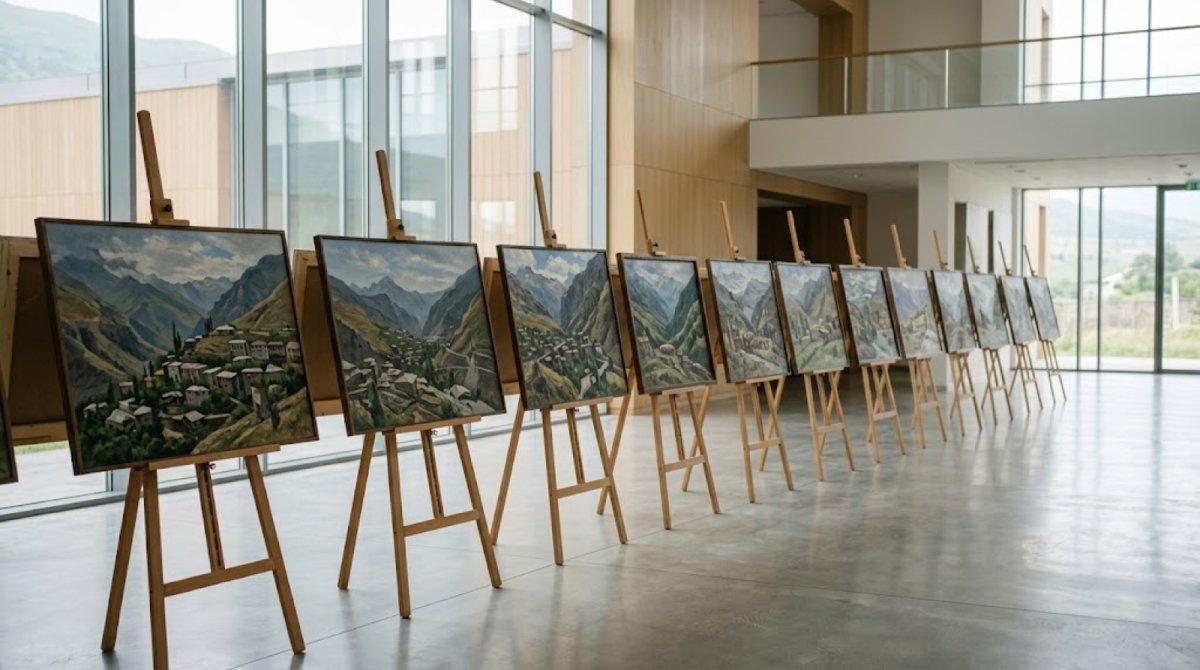
Azerbaijan's cultural institutions are turning the reconstruction of Karabakh into narrative and image. On Sunday, Report.az reported on two projects that surfaced within hours of each other: a documentary tracing the return of residents to rebuilt towns, and a fine-arts symposium in Khankandi that brought women painters from several Turkic countries to record the region's landscapes and construction sites.
The film, titled "Sabaha doğru" (Towards Tomorrow), was produced by the Azerbaijan Journalists Network Public Union and focuses on the rebuilding of Karabakh and Eastern Zangazur and on the state's Great Return program, under which former residents are being resettled. According to Report.az, it was prepared as part of the "Year of Urban Planning and Architecture" and tells the story of reconstruction through the personal accounts of people moving back, with an emphasis on newly built settlements designed around modern architecture and people-centered planning.
Filming took place across nine locations: Aghdam, Jabrayil, Fuzuli, Kalbajar, Lachin, Shusha, Khankandi, Khojaly and Zangilan. The screenplay was written by Ayaz Mirzayev, the director is Zaka Gulu, Emin Huseynov served as cinematographer and Elmar Tariyeloghlu edited the film. The production is part of a project called "Reconstruction and Cities of the Future in Karabakh and Eastern Zangazur," financed by the State Support Agency for Non-Governmental Organizations, the outlet said.
Turkic painters in Khankandi
The second event took place in Khankandi, the city known to Armenians as Stepanakert, which came under Azerbaijani control after the September 2023 military operation that was followed by the departure of the area's ethnic Armenian population. At the initiative of TURKSOY, the International Organization of Turkic Culture, a five-day symposium and exhibition gathered women artists from Turkic states. TURKSOY organized the program together with the public relations department of the Restoration, Construction and Management Service for Khankandi city and the Aghdara and Khojaly districts, Report.az reported.
The participants toured the region during the symposium and recorded their impressions in paintings. The resulting exhibition, staged at the Khankandi Cultural Center, presented Karabakh's landscapes and urban views, sites of its historical and cultural heritage, and the building and restoration work now under way. Organizers said the goal was to bring together women artists from across the Turkic world, deepen cultural cooperation among Turkic nations and create a space for exchanging experience and ideas in the fine arts.
Those attending included TURKSOY Secretary General Sultan Raev; Sabuhi Gahramanov, deputy special representative of the Azerbaijani president for Khankandi city and the Aghdara and Khojaly districts; and Farrukh Jumayev, head of the international relations department at the Ministry of Culture. The Lankaran State Drama Theater performed for guests during the program.
What it means
Taken together, the two projects show a coordinated cultural layer being added to the physical rebuilding of Karabakh. The documentary is state-funded through the NGO support agency and structured around the Great Return program, which means the story of resettlement is being told in the government's own frame of urban planning and modern architecture. The TURKSOY symposium extends that frame outward: by placing painters from other Turkic countries in Khankandi and exhibiting their work there, Baku is inviting the Turkic world to see the region as a shared cultural space rather than a contested one. For the Organization of Turkic States' cultural arm, the choice of venue is itself a statement of alignment with Azerbaijan's post-2023 order, and it comes in the same week that composers' bodies from seven countries founded a Turkic Union of Composers in Baku. The audiences for both projects, domestic returnees and Turkic partners, indicate where Azerbaijan expects the reconstruction narrative to matter most.
What's Your Reaction?
 Like
0
Like
0
 Dislike
0
Dislike
0
 Love
0
Love
0
 Funny
0
Funny
0
 Wow
0
Wow
0
 Sad
0
Sad
0
 Angry
0
Angry
0










Comments (0)