

Minaret of Jam repairs test Taliban's calculated turn on cultural heritage
Emergency work on Afghanistan's UNESCO-listed minaret, backed by the Aga Khan Trust and ALIPH, shows the Taliban courting heritage bodies, experts say.

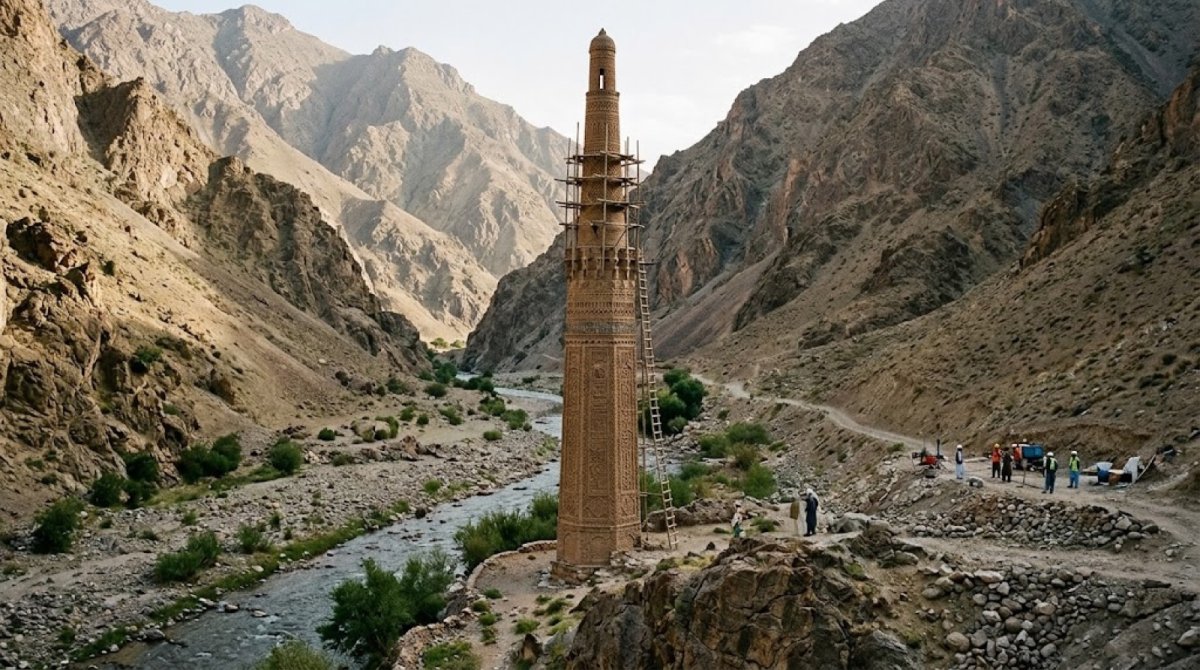
Emergency stabilization work is under way on the Minaret of Jam, Afghanistan's best-known medieval monument, in a project that conservation specialists say reflects a calculated shift in how the Taliban handle cultural heritage compared with the group's first period in power in the 1990s, Radio Free Europe/Radio Liberty reported Sunday.
Images of the work surfaced in mid-September when a Taliban official traveled to the 12th-century tower, set in a remote valley of Ghor Province, to inspect rehabilitation efforts that reportedly started in July. A spokesperson linked to the Aga Khan Trust for Culture told RFE/RL the project includes "emergency intervention to consolidate a critical section of the inner masonry column at the base of the minaret." The brick structure had been damaged repeatedly by flooding and was long considered at risk of collapse.
Who is doing the work
The Aga Khan Development Network says its study of the minaret is a three-way effort with the Taliban-run Culture Ministry and ALIPH, a heritage foundation headquartered in Geneva. The study is scheduled to wrap up in 2027 and, in the network's words, "will result in recommendations to the Afghan authorities on further scientific measures required to secure the site."
Jolyon Leslie, a British conservation architect based in Afghanistan since the early 1990s who also worked with the 1996-2001 Taliban government, said the current authorities appear "more worldly about cultural issues, and conscious of their image in being seen to protect their heritage." Leslie, who works with the Afghan Cultural Heritage Consulting Organization, said that "since 2021 [the Taliban authorities have] been largely supportive of conservation work and have not interfered in our work, which has included Buddhist and Jewish heritage."
From Bamiyan to a preservation edict
The contrast with the past is stark. In February 2001, the first Taliban leadership decreed that statues and non-Islamic shrines be destroyed; the Bamiyan buddhas were blown up and thousands of ancient statues in the National Museum of Afghanistan in Kabul were smashed in the months that followed, shortly before the group was driven from power. Leslie, the only Westerner at a meeting in the Kabul museum shortly after the Taliban returned in 2021, later recalled a Taliban official hinting at regret over the 2001 destruction because of the global outrage it provoked.
The rhetorical shift came before the takeover. In February 2021 the group issued an edict calling on "all mujahedeen" to "preserve all historic sites like old fortresses, minarets, towers and other similar sites to safeguard them from damage, destruction and decay." Many curators were skeptical and moved treasures to secret storage as the Taliban advanced on Kabul. Yet after the capital fell, the National Museum reopened under armed Taliban guard, and several restoration projects have since been approved, including a synagogue in Herat Province.
Gil Stein, a University of Chicago archaeology professor who led the effort to restore the museum's shattered statues, cautioned against reading too much into the change. "Like everything about Afghanistan, the situation is complex and contradictory. The most basic principle is that we cannot consider the Taliban government as unitary and monolithic," he told RFE/RL, noting the gap between what he called draconian policies on women and more nuanced heritage policies that vary by region and by distance from Kabul. "Overall, it looks to me that the Taliban's overall ideology has not changed, but they have become more pragmatic and careful in how they implement their cultural heritage policies in the places where it is most visible to foreigners," Stein said. The Taliban have sharply curtailed women's and girls' access to work and education and require them to be fully covered in public.
What it means: The Jam project shows a workable channel between the Taliban authorities and international heritage institutions that does not require political recognition: a Geneva foundation, an Aga Khan agency and a Taliban ministry are sharing a research program with a 2027 deadline. For Kabul's rulers, visible protection of a UNESCO site buys reputational credit at low cost, precisely at the points where foreigners are watching, as Stein observes. For donors and neighbors across Central Asia, at a time when Pakistan is blaming the Afghan Taliban for cross-border militancy, that is a signal of where limited engagement can proceed, but the experts' own caveats indicate it is not evidence of a broader ideological change.
What's Your Reaction?
 Like
0
Like
0
 Dislike
0
Dislike
0
 Love
0
Love
0
 Funny
0
Funny
0
 Wow
0
Wow
0
 Sad
0
Sad
0
 Angry
0
Angry
0













Comments (0)