

Bangkok declares citywide disaster as three days of rain swamp 50 districts
Nearly 300 millimeters of rain since Thursday put all 50 Bangkok districts under disaster declaration, with drainage expected to take days.

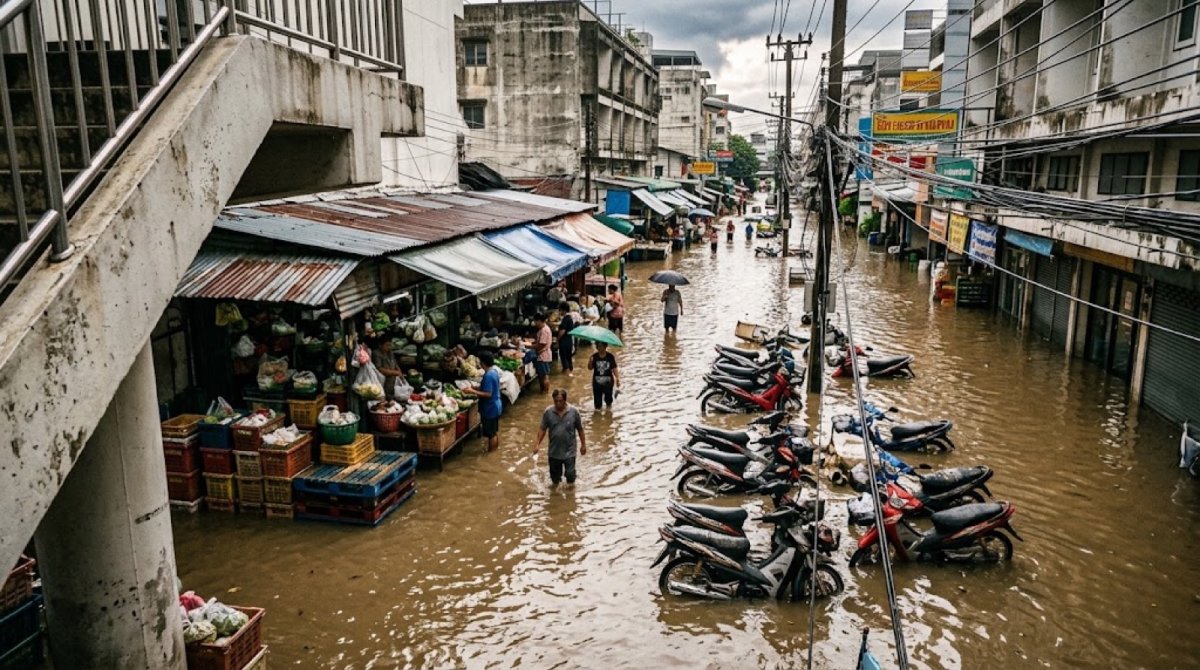
Bangkok has been declared a disaster zone across all 50 of its districts after three days of near-continuous rain left roads, canals, homes and shops under water.
Governor Chadchart Sittipunt said nearly 300 millimeters, about 12 inches, of rain had fallen on the city since Thursday afternoon, overwhelming a drainage system that relies on canals to move water out. "The rain keeps falling and we are doing our best. We are trying to pump the water out, but the water in canals are full," he said.
Eastern districts were worst affected. Officials told residents to move vehicles to higher ground and opened metro parking free of charge until Oct. 2. By Saturday the government said conditions had stabilized, while cautioning that clearing the water would take two to three days if no further rain fell. The Department of Disaster Prevention and Mitigation said a persistent low-pressure system would keep the risk of flash floods, forest runoff, mudslides and river overflow in place through Sunday.
Not a flash flood
What sets this episode apart from an ordinary monsoon downpour is its duration. Al Jazeera's correspondent in the city, Tony Cheng, reported "persistent heavy rain since Thursday evening" across the whole of Bangkok rather than in isolated pockets. Somkid Pheuk-ngam, a 67-year-old vendor, said the water where he works had reached waist height. "The water keeps coming in. It's hard to go out now," he said, calling the flooding worse than the 2011 disaster that killed more than 500 people across Thailand.
The emergency lands as forecasters warn about the strength of the current El Nino. Euronews reported this week that sea surface temperatures in the equatorial Pacific have already passed the highest levels recorded in earlier events. It cited a study published in August finding that El Nino episodes now run 36% stronger than before the industrial era. UN Secretary-General Antonio Guterres said the pattern "is being supersized before our eyes," adding: "The planet is in uncharted waters, and those waters are heating up."
Davide Faranda, a research director at France's National Centre for Scientific Research and a lead author for the Intergovernmental Panel on Climate Change, told Euronews that the answer lies in handling water rather than preventing the cycle. "We cannot eliminate El Nino through climate mitigation, but we can reduce the extent to which climate change makes its consequences more severe," he said. The same outlook has already produced below-normal monsoon rainfall in India, a heightened drought risk in southern Africa and a state of emergency in California over flooding and landslides.
For a city built barely above sea level on a river delta, the practical question is capacity: pumps, canals and retention areas sized for a rainfall pattern that no longer holds. Governments across Asia are running the same calculation, weighing the cost of drainage and storage against the price of repeated emergencies, an argument that also runs through the case developing countries make about who caused the warming.
What it means: Bangkok's flood is a governance stress test more than a surprise. The city knows it sits on a subsiding delta and has known since 2011 what a saturated drainage network produces, which is why the response is being measured in pumping days rather than evacuations. The wider signal reaches water managers from the Mekong to the Amu Darya: an El Nino arriving stronger than its predecessors will not only push floods into some basins and drought into others, it will do so on a timetable existing infrastructure was never built to absorb. The cheapest defenses, retention space and maintained channels and honest floodplain maps, are also the ones that take years to put in place.
What's Your Reaction?
 Like
0
Like
0
 Dislike
0
Dislike
0
 Love
0
Love
0
 Funny
0
Funny
0
 Wow
0
Wow
0
 Sad
0
Sad
0
 Angry
0
Angry
0
















Comments (0)