

Kazakhstan releases more kulans into Ile-Balkhash as tiger return nears
Wild asses from Altyn Emel join a reserve where two Amur tigers already live and four more are due from Russia, building the prey base for a comeback.

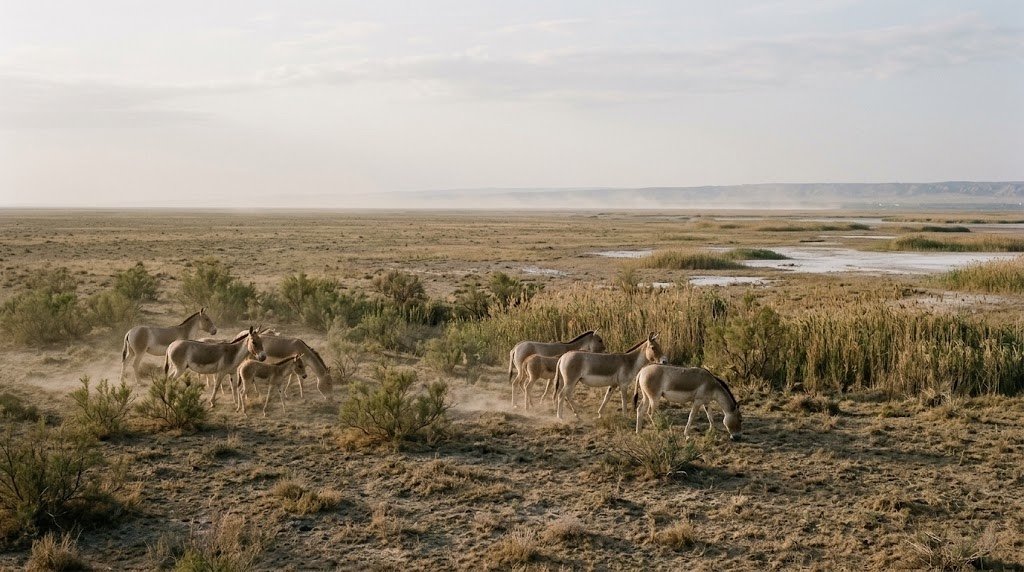
Kazakhstan has released a fresh group of kulans, the wild ass of the Central Asian steppe, into the Ile-Balkhash State Nature Reserve, the Ministry of Ecology and Natural Resources said, in the latest step of a program that is rebuilding the prey base for the planned return of tigers to the country. The animals were brought from Altyn Emel National Park and set loose in their natural habitat, The Astana Times reported on Sept. 19. Specialists will now track how the herd adapts, where it moves and how its condition holds up.
The ministry's kulan reintroduction project has been under way since 2017, Qazinform reported when it first covered the relocation on Sept. 14, and is run together with the Altyn Dala Initiative, a collaboration with international conservation groups. The stated aim is to restore natural populations, widen the species' range and strengthen biodiversity in the south of the country.
An animal that vanished, then came back by island
The kulan is native to the steppes and semi-deserts of Central Asia. Hunting and the loss of habitat wiped it out across most of its former Kazakh range before 1950, The Astana Times noted. An earlier Qazinform account of the program traces the revival to a small founding herd: between 1953 and 1961, 14 kulans were brought from Turkmenistan to Barsa-Kelmes Island in the Aral Sea, where the population grew to about 200 before animals were moved to the mainland at Altyn Emel.
That park has since become the donor for every new population. Qazinform reported that 60 kulans were moved to Ile-Balkhash in 2022 and more than 40 in October 2024, when the ministry worked with the U.N. Development Programme and fitted three animals with telemetry collars. The same month, 24 kulans were driven 2,139 kilometers, a 50-hour journey, from Altyn Emel to the Altyn Dala Nature Reserve in central Kazakhstan, a transfer the ministry used to refine safer methods of moving the animals over long distances, The Astana Times said.
By the 2025 census Kazakhstan counted 4,702 kulans, and 66 had been relocated under the restoration effort, including 42 to Ile-Balkhash and 24 to Altyn Dala, the newspaper reported in August. Altyn Dala is also home to 14 Przewalski's horses, with a further 40 due to arrive by the end of 2029, and the country's three saiga populations numbered close to 3.98 million animals in 2025.
Building a food chain for tigers
Ile-Balkhash is the centerpiece of Kazakhstan's plan to bring tigers back more than 70 years after they were wiped out. The reserve, established in 2018, covers more than 415,000 hectares of the Ili River delta, including tugai and saxaul forests and wetlands on the southern shore of Lake Balkhash, according to an April report in The Astana Times. Two Amur tigers, Kuma and Bogdana, have lived there since September 2024 and, the Forestry and Wildlife Committee said, have adapted well; four more Amur tigers are expected from Russia this year under a bilateral agreement. Amur tigers are regarded as the closest living relatives of the extinct Turanian subspecies that once roamed the region.
Before a big cat can be set free, it needs something to hunt. The April report put the number of kulans already introduced to the reserve at 119, alongside roughly 200 Bukhara deer released into the wild. The ministry describes the kulan as a large herbivore whose grazing shapes vegetation and anchors the food chain, which is why each new herd is framed as part of creating suitable conditions for the tiger's eventual return.
What it means
Kazakhstan's rewilding has moved from protecting what survived to actively re-assembling an ecosystem, and the kulan releases are the working parts of that machine. The numbers show a pipeline: a single donor park at Altyn Emel feeding two distant reserves, relocation techniques tested on the 2,139-kilometer Altyn Dala run, collared animals providing data, and a prey population being stacked up in the Ili delta ahead of tigers that are already on site. For a country better known abroad for oil and uranium, the program offers a different kind of standing, one that draws in UNDP and international conservation partners and gives the Balkhash region a basis for nature tourism built on animals that had been gone for generations. The measure of success will be simple: whether the newly released kulans hold their ground through the coming winter, and whether the four tigers promised from Russia arrive and, in time, are let out to hunt them.
What's Your Reaction?
 Like
0
Like
0
 Dislike
0
Dislike
0
 Love
0
Love
0
 Funny
0
Funny
0
 Wow
0
Wow
0
 Sad
0
Sad
0
 Angry
0
Angry
0















Comments (0)