

Moscow and German Far-Right AfD Reportedly Prepare Talks on Resuming Russian Gas Supplies
Russian special envoy Kirill Dmitriev and the leadership of Germany’s far-right AfD party are preparing for potential talks in March 2027 to discuss the resumption of Russian gas deliveries and the Nord Stream pipelines, according to Reuters.

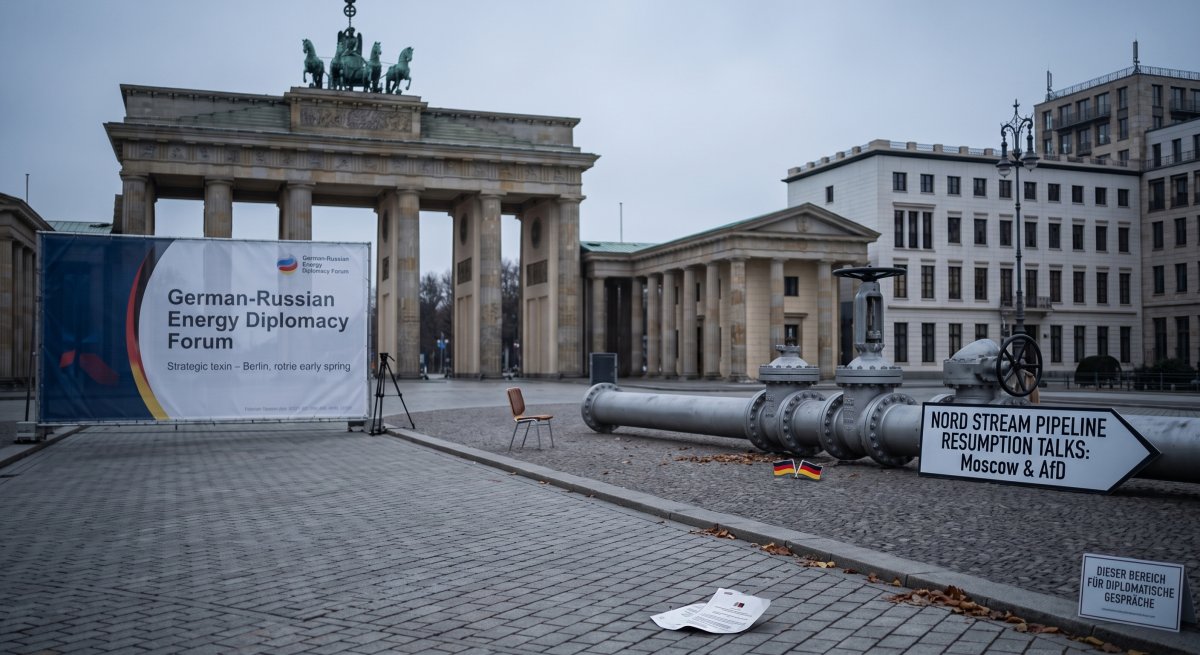
Russian special envoy Kirill Dmitriev and the leadership of Germany’s far-right Alternative for Germany (AfD) party have initiated preparations for a meeting to discuss the resumption of Russian gas supplies to Germany, Reuters reported, citing two sources familiar with the initiative. The meeting could take place as early as March 2027.
According to the agency, participants are expected to include Dmitriev—head of the Russian Direct Investment Fund and a close adviser to Vladimir Putin—alongside AfD co-leaders Alice Weidel and Tino Chrupalla. Representatives for both the AfD and Dmitriev declined to comment.
Sources noted that the meeting would be contingent on Russia and Ukraine first finalizing a framework peace agreement. Organizers also hope to involve U.S. representatives, with Israel, the United Arab Emirates, and India being considered as potential host locations. However, a senior U.S. administration official told Reuters that Steve Witkoff and Jared Kushner have not been briefed on the preparations and have received no invitations.
The agenda is set to include the potential revival of the Nord Stream gas pipelines. Dmitriev previously met with Witkoff and Kushner in Moscow in September.
Weidel has repeatedly advocated lifting the boycott on Russian oil and gas, arguing that cheap energy resources are essential to restoring the competitiveness of German industry. Prior to the sanctions imposed after the start of Russia's full-scale invasion of Ukraine in 2022, Russia supplied more than half of Germany’s natural gas imports and over a third of its crude oil.
For the AfD, such a meeting serves to showcase foreign policy capability and position the party as a viable governing alternative amid elevated energy costs. The party recently secured a historic state-level election victory in Saxony-Anhalt and faces another electoral test in Mecklenburg-Western Pomerania, where the Nord Stream pipeline landfall points are located.
Simultaneously, discussions are taking place in Washington regarding potential bilateral economic arrangements with Moscow even before hostilities in Ukraine formally conclude. According to The New York Times, preliminary considerations cover energy and investment portfolios as a demonstration of serious intent to normalize relations, though opinion within the White House remains divided on timing and feasibility.
Any return of Russian energy supplies faces intense domestic and European opposition. Green Party lawmaker Michael Kellner warned that Germany must avoid renewing its dependency on Moscow, noting the post-2022 energy crisis cost the country roughly €50 billion. Kellner labeled any return to previous supply frameworks a "betrayal," adding that the Kremlin is leveraging the AfD for its own geopolitical agenda.
Lawmakers from the center-right CDU issued similar warnings. Roderich Kiesewetter described the AfD’s stance as overtly pro-Russian, cautioning that restarting Nord Stream operations would compromise European security and isolate Berlin internationally.
Substantial technical and legal hurdles remain. Three of the four Nord Stream pipelines were severely damaged by underwater explosions in September 2022, while the surviving string of Nord Stream 2 was never certified by German regulators. In addition, European Union restrictions and the bloc's official target to eliminate Russian fossil fuel imports by 2027 present direct regulatory barriers.
While the AfD does not hold power at the federal level, the preparations highlight growing undercurrents across Europe and the United States regarding the future architecture of post-war energy ties with Moscow.
What's Your Reaction?
 Like
0
Like
0
 Dislike
0
Dislike
0
 Love
0
Love
0
 Funny
0
Funny
0
 Wow
0
Wow
0
 Sad
0
Sad
0
 Angry
0
Angry
0










Comments (0)