

German recycler bets on water to loosen China's grip on Europe's lithium
Accurec's Krefeld plant recovers lithium from spent batteries with a water-based process, targeting 20,000 metric tons a year and 80% recovery by 2027.

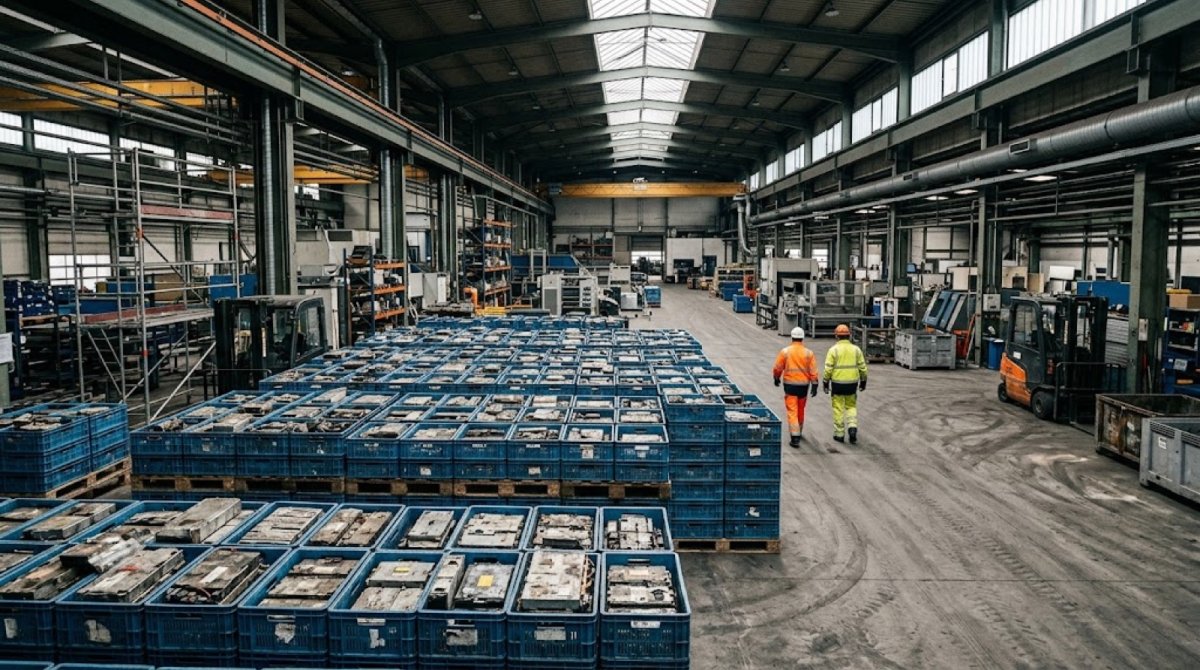
Europe's plan to build batteries without leaning on China keeps colliding with the same bottleneck, and it is not mining. It is chemistry. A recycler in Krefeld, in Germany's industrial west, says it can pull battery-grade lithium out of spent cells using water rather than shipping the problem to Asia.
Accurec Recycling GmbH, founded in 1995, processes about 5,000 metric tons of batteries a year in Krefeld with a workforce of roughly 85, and runs a second recycling plant in Mulheim an der Ruhr. In December 2025 it opened a dedicated lithium recovery facility. It initially captures 50% of the lithium contained in the batteries it treats, enough to satisfy the European Union's 2027 requirement, and is aiming for 80% or more by the first quarter of 2027.
The company is spending 5.5 million euros to double the plant's operating area and lift throughput toward 20,000 metric tons a year, four times its current volume. "We have been working on expanding the plant for about a month now," said Simon Bremer, Accurec's head of development.
Filter coffee, but for metal
The process, which the company calls CLIMA, uses pyrolysis to change the lithium's form before water does the separating. "We convert the lithium into a water-soluble form. In other words, the entire rest of the battery is insoluble in water, except for the lithium," Bremer said, likening the step to pouring water over ground coffee. Heat already present in the process is reused rather than added: "That allows us to avoid using additional energy and thus reduce overall process costs," he said. Accurec puts the result at nearly 50% less energy and more than 59% lower carbon dioxide emissions per metric ton of lithium carbonate.
That matters because of where the value currently lands. China produces 65% to 70% of the battery-grade lithium chemicals used in Europe. Most European recyclers stop at "black mass," an intermediate powder, and export it. "The actual recovery of raw materials then takes place predominantly in China, and partly in Korea," Bremer said.
Brussels has started closing that route. Black mass has been classified as hazardous waste since December 2025, restricting its export, and mandatory recycled-content rules for new batteries begin in 2031. Bremer supports both and wants the rules to go further by crediting where recycled material is processed, not merely that it was recycled. "That is an important step and, from our point of view, absolutely the right one to say: the material has to stay in Europe," he said. Accurec's lithium is destined for AMG Lithium in Bitterfeld, with work continuing on "ironing out the final interface issues" before deliveries start.
The industrial backdrop is unforgiving. Northvolt's collapse into insolvency removed Europe's flagship attempt to build a domestic battery champion, and recyclers need a dependable flow of factory scrap and end-of-life packs that a thinner supply chain does not generate by itself. Germany's fast-growing electric fleet will eventually supply that flow, but those packs are still on the road.
What it means: Europe spent three years learning that buying gas from a single supplier was a strategic choice dressed up as a commercial one. Lithium chemicals are the same lesson in a smaller package. The tonnage is trivial next to oil, but without recovery and refining capacity on the continent, every battery target Brussels writes is effectively a purchase order addressed to Chinese processors. A plant of that scale in Krefeld does not change that arithmetic on its own. It does show the missing step is industrial rather than geological, and that the decisive policy lever is the one Bremer is asking for: tying credit to where the metal is actually processed.
What's Your Reaction?
 Like
0
Like
0
 Dislike
0
Dislike
0
 Love
0
Love
0
 Funny
0
Funny
0
 Wow
0
Wow
0
 Sad
0
Sad
0
 Angry
0
Angry
0











Comments (0)