

Serbia holds fuel exports back through October as Vucic calls Putin
Serbia's caretaker government barred oil and fuel exports until Oct. 31, and President Aleksandar Vucic telephoned Vladimir Putin the same week.

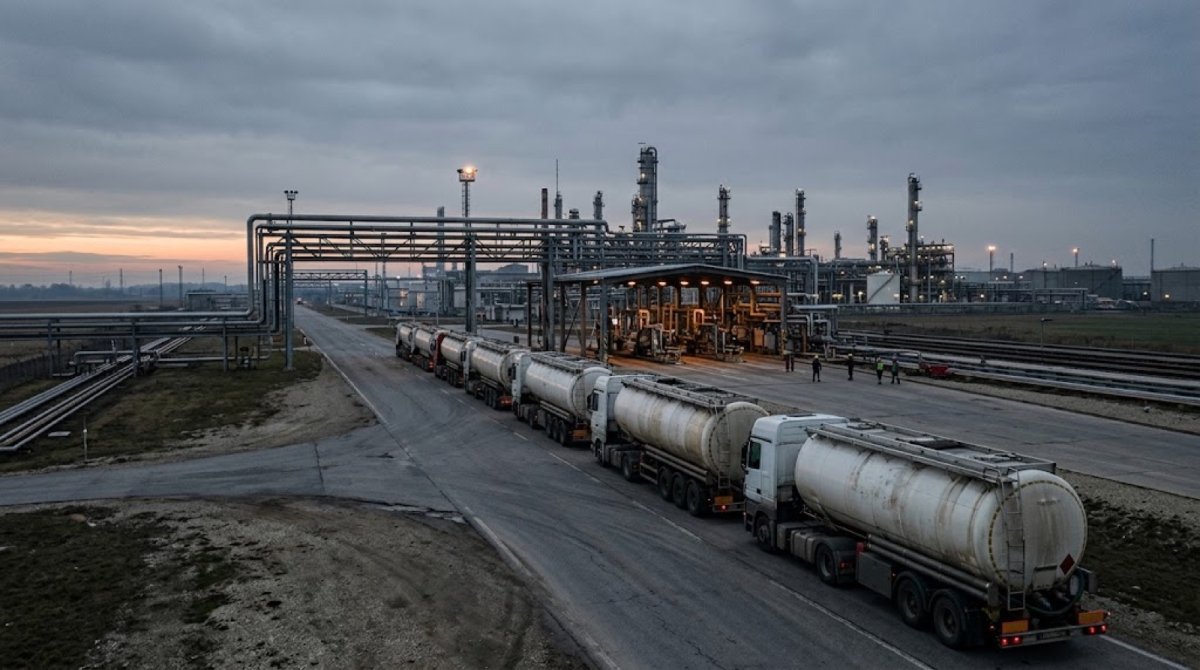
Serbia will keep crude oil and refined fuel inside its own market for another month, after the caretaker government in Belgrade extended an export ban that had been due to expire on Sept. 30.
The prohibition now runs through Oct. 31. The government adopted the decision on Sept. 24 and published it in the official gazette, Sluzbeni glasnik, Report.az reported. It applies to crude oil and to petroleum products, the category that covers the diesel and gasoline traded across the western Balkans.
Serbia is an unusual case in the region. It is an EU candidate that has not aligned itself with the bloc's sanctions on Russia, and its refining sits with NIS, in which Russia's Gazprom Neft holds the controlling stake. That combination leaves Belgrade managing its fuel balance politically as well as commercially, and a blanket export ban is the bluntest instrument available for keeping domestic storage filled.
A call to Moscow in the same week
The extension landed in the same week that Vucic telephoned Putin. The Kremlin press service said the call was made at the initiative of the Serbian side and that the two leaders spoke in what it described as a warm and friendly atmosphere, according to TASS, the Russian state news agency.
By Moscow's account, Vucic congratulated Putin on Russia's State Duma elections, briefed him on preparations for Serbia's own early parliamentary elections, and thanked Russia for assistance that included help with forest fires. The two also discussed the conflict in Ukraine and the situation in the Balkans. The Kremlin readout is the public description of the conversation that has circulated so far.
For Serbia's neighbors, the export ban is the more immediate fact. It tightens a regional fuel market that has been under strain for months: pump prices across the European Union set records over the summer, a squeeze that laid bare how much of Europe's diesel still rides on distant chokepoints. Hungary has spent September arguing with Kyiv over who is entitled to store refined product where. Across Central and Southeastern Europe, the pinch point is storage and transit rather than production.
An export ban also carries a cost. Refiners and traders lose the margin that comes from selling into neighboring markets, and repeated one-month rollovers make it harder for buyers on either side of Serbia's borders to plan beyond the next gazette entry.
What it means: A one-month ban is a holding action rather than a policy. It signals that Belgrade does not yet trust its own supply chain to carry it through the fourth quarter, and that it would rather absorb lost export revenue than risk a domestic shortage in the run-up to an early election. The parallel line to Moscow is the other half of the same posture. Serbia keeps its fuel at home and its options open, declining to choose between the market it wants to join and the shareholder that controls its refining. Each rollover buys a few more weeks of that ambiguity, and each one makes the choice a little more expensive to keep deferring.
What's Your Reaction?
 Like
0
Like
0
 Dislike
0
Dislike
0
 Love
0
Love
0
 Funny
0
Funny
0
 Wow
0
Wow
0
 Sad
0
Sad
0
 Angry
0
Angry
0










Comments (0)