

Nvidia's Huang tells Kazakhstan to turn its energy into AI on first visit
Jensen Huang said Kazakhstan has the power, talent and computing base to build its own AI industry, as GPU projects in Astana and Ekibastuz expand.

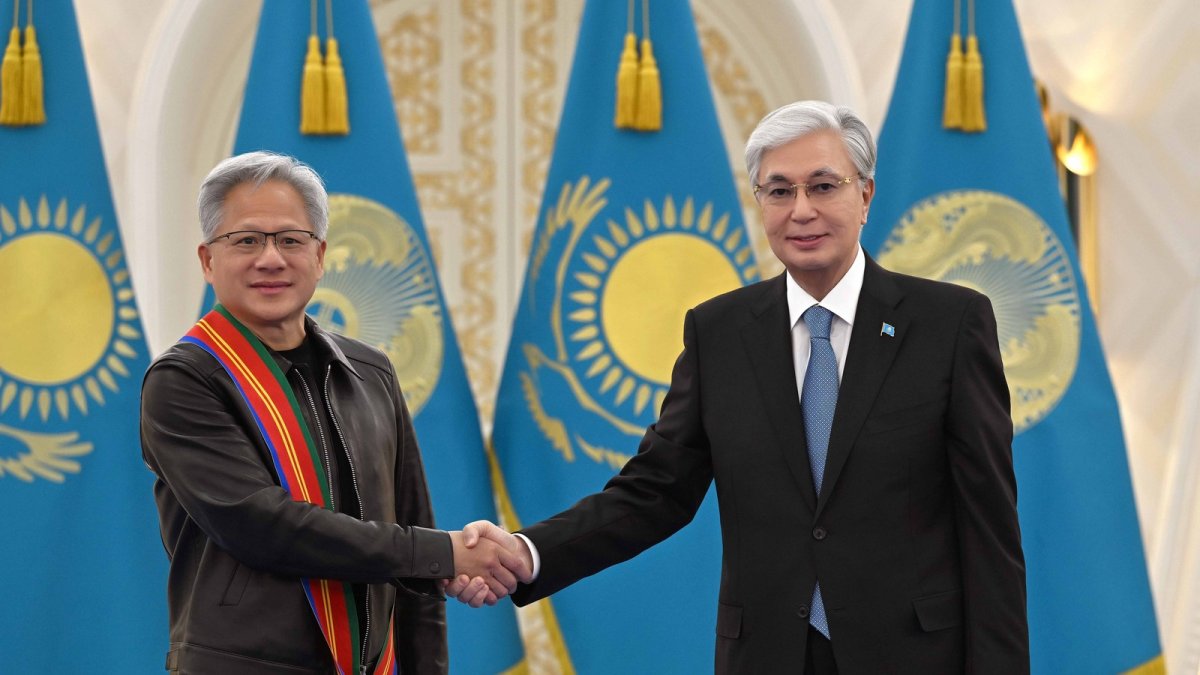
Nvidia co-founder and CEO Jensen Huang made his first visit to Kazakhstan on Oct. 23, telling his hosts that the country already has the energy, engineering talent and computing infrastructure it needs to build a domestic artificial intelligence industry, The Astana Times reported. The trip marked the close of Kazakhstan's AI Month.
"In just a very short time, frankly, you have made incredible progress," Huang said. "This is the first country that I have been to where the president declared the country to be an AI nation." President Kassym-Jomart Tokayev has placed AI at the center of his economic agenda, and the government now has a dedicated ministry for the sector, led by Deputy Prime Minister Zhaslan Madiyev, who also serves as minister of artificial intelligence and digital development.
Energy as the raw material
Huang built his pitch around Kazakhstan's resource base. "Kazakhstan has a fundamental advantage because you have so many natural resources already," he said, adding that "instead of just exporting energy in the future, you can transform the energy into intelligence." He described large computing centers as "AI factories" and said: "These AI factories require natural resources and the natural resources it needs is electricity."
He also framed data as a sovereign asset. Calling control over national data "a national security concern," Huang told the audience: "That data belongs to you, just as your natural resources belong to you." He pointed to the country's pool of software developers, saying: "You have so many programmers, developers. You are rich with expertise here."
The hardware behind the ambition
The visit comes as several GPU projects move forward. U.S.-based Firebird has signed an investment agreement with the Kazakh government and obtained a U.S. export license covering 45,000 Nvidia Grace Blackwell GPUs, according to The Astana Times. State operator Kazakhtelecom has installed 880 Nvidia GPUs in Astana and Almaty and plans to add more than 2,000 in 2027.
- Nvidia is taking part in the first phase of a Kazakhtelecom facility at the Data Center Valley project in Ekibastuz, in the country's northeast.
- More than 1,000 Nvidia Vera Rubin processors are planned for the Ekibastuz site in 2027.
- Commercial operations there are expected to start in the third quarter of 2027.
Huang said Kazakhstan could become a center for physical AI, the use of AI systems in industries such as mining, agriculture, logistics and energy. "Now, we are at the beginning of the physical AI journey. This is the next wave," he said. He added: "The first thing and the last thing is you invest in people, not companies."
Talks at Akorda
Huang also met Tokayev at Akorda, the presidential residence in Astana, on Oct. 23, according to the presidential press service. Tokayev described artificial intelligence and digitalization as national priorities, noting that 2026 had been declared Kazakhstan's Year of Digitalization and Artificial Intelligence, and welcomed Nvidia's partnership with Higgsfield.
Huang proposed that Kazakhstan become a global hub for physical AI, the press service said. "This new industry requires energy at its foundation, it also requires a population dedicated to science, math and technology. You have richness in both," he said, citing partnerships with Firebird AI KZ Ltd and Kazakhtelecom and Nvidia's investment in Higgsfield, which he called Kazakhstan's first unicorn. At the end of the meeting, Tokayev awarded Huang the Order of Dostyk (Friendship), first degree, in recognition of his contribution to the development of AI in Kazakhstan.
A regional race for compute
Kazakhstan is not alone in courting the sector. Its neighbors are pitching similar offers, from Azerbaijan, where Baku is offering its grid to the AI build-out, to Uzbekistan, which is betting on wind power and data centers in Karakalpakstan. Each is trying to turn surplus electricity and land into a place in the global supply chain for computing.
What it means: Huang's visit gives Astana a rare endorsement from the company that controls the most sought-after chips in the AI economy, and his framing, energy converted into intelligence, aligns neatly with Kazakhstan's goal of moving beyond raw commodity exports. The decisive factor, however, is access rather than rhetoric: Firebird's U.S. export license for 45,000 GPUs shows how heavily U.S. export approvals shape the pace at which Central Asian AI projects can scale. Kazakhtelecom's current base of 880 GPUs remains small next to those plans, so the Ekibastuz timeline for 2027 will be the real test of whether the country becomes a regional compute hub or remains a promising site on paper.
What's Your Reaction?
 Like
0
 Dislike
0
 Love
0
 Funny
0
 Wow
0
 Sad
0
 Angry
0












Comments (0)