

Lavrov says Russia-US diesel deal is no business of Kyiv as volumes ramp up
Moscow plans to raise diesel supplies from 300,000 tons in October to 1 million in December under a U.S. license Zelenskyy called a "weak decision."

Russian Foreign Minister Sergey Lavrov said on Sunday that the diesel arrangement between Moscow and Washington concerns only the two capitals, dismissing objections from Ukrainian President Volodymyr Zelenskyy, TASS reported.
"The diesel deal between Moscow and Washington is a matter for Moscow and Washington," Lavrov told a news conference in Manama, Bahrain, after the ninth round of the Russia-Gulf Cooperation Council Strategic Dialogue, according to the Russian state news agency. Responding to what TASS described as Zelenskyy's claim that only he could permit Russian diesel exports, Lavrov said: "It is a matter of self-promotion and yet another farce." TASS reported that he also cast objections from the European Union as political posturing rather than a question of energy security.
What the arrangement involves
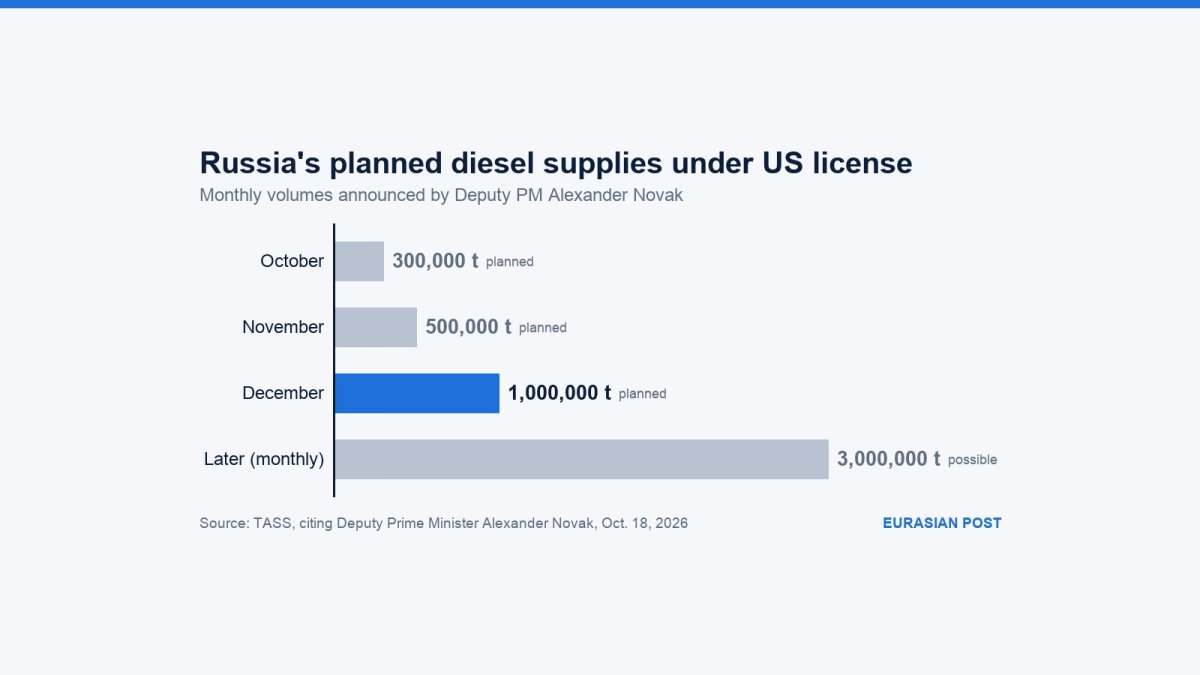
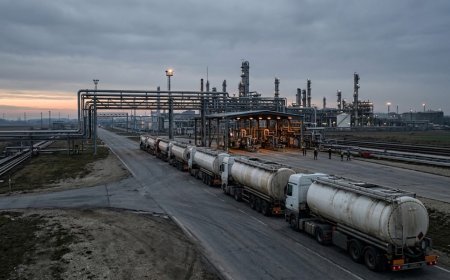
The deal traces back to an Oct. 9 phone call between Russian President Vladimir Putin and U.S. President Donald Trump. Afterward, Trump said Russia would "immediately supply over 300,000 Tons of Diesel Fuel to the American and Global Marketplace," followed by 500,000 tons in November and a later release of 1 million tons, Kuwait Times reported. The Kremlin said Russia had "reaffirmed its readiness to supply oil and oil products to the American and world markets," according to the same report.
The U.S. Treasury's Office of Foreign Assets Control issued General License No. 135, authorizing transactions in Russian-origin diesel, Ukrainska Pravda reported. Reports differ on its end date: TASS gave April 7, 2027, while Ukrainska Pravda gave April 17, 2027; both place the expiry in April 2027.
According to TASS, Deputy Prime Minister Alexander Novak set out a schedule of 300,000 tons in October, 500,000 tons in November and 1 million tons in December, with monthly supplies possibly reaching 3 million tons later. TASS also reported that Russia would lift its diesel export ban ahead of schedule.
Kyiv's objection
Zelenskyy criticized the U.S. move in an Oct. 9 interview with Axios. "You know, it looks like a happy birthday present for Putin. It looks absolutely terrible," he said, according to Ukrainska Pravda, adding: "At precisely the moment when we are talking about peace, America is allowing Russia to export diesel." He said the deal would give Russia additional revenue for the war. In an Oct. 10 report, Kuwait Times quoted him as saying: "It is certainly not honest, it is certainly unworthy of our partners, and it is, in my view, a weak decision."
The deal lands in a tight fuel market. Average U.S. regular gasoline prices had risen 46% since late February to $4.37 a gallon, and diesel 67% to $6.28, after U.S.-Israeli strikes on Iran led Tehran to block the Strait of Hormuz, Kuwait Times reported. Europe has been bracing too, opening its diesel reserves under the threat of a U.S. export ban. Diplomacy on the war continues on a separate track, with U.S. envoys hosting talks in Miami.
What it means: Lavrov's framing is the point. By insisting the deal belongs to Moscow and Washington alone, Russia is treating fuel supply as a bilateral bargaining chip with the United States, separate from the war and from Kyiv's veto. For Washington, the license is a lever on domestic fuel prices during a Gulf supply shock; for Moscow, it is a channel for revenue and for reopening direct economic dealings with the U.S. For Ukraine, it is the loss of leverage that sanctions were meant to provide. The stepped volumes give the arrangement a built-in test: whether Russia delivers on the schedule, and whether the license survives to its April 2027 expiry, will show how far energy has re-entered the great-power bargaining around the war.
What's Your Reaction?
 Like
0
 Dislike
0
 Love
0
 Funny
0
 Wow
0
 Sad
0
 Angry
0








Comments (0)