

Uzbek arrivals jump a third as Central Asian tourism to Azerbaijan climbs 12%
Central Asian visitors to Azerbaijan rose 12.3% in January-August even as total foreign arrivals fell 8%, led by a 33.2% surge from Uzbekistan.

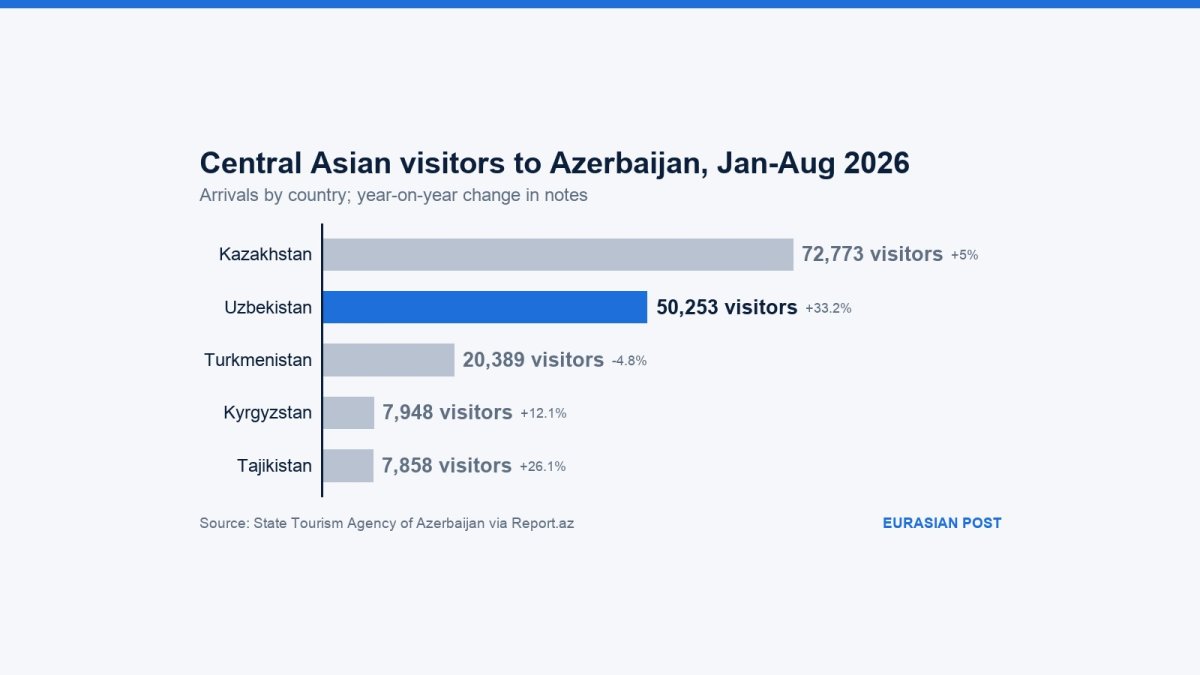
Visitors from Central Asia to Azerbaijan rose 12.3% in the first eight months of 2026, bucking a decline in the country's overall foreign arrivals, according to State Tourism Agency data published by Report.az on Saturday.
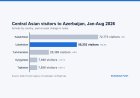
Azerbaijan received 159,221 visitors from the five Central Asian states in January-August, up from 141,795 in the same period of 2025. Over those eight months, total foreign arrivals fell 8% to 1.585 million from 1.72 million a year earlier. The regional gain therefore came against the direction of the wider market rather than with it.
Uzbekistan leads the growth
Kazakhstan remained the largest Central Asian source market with 72,773 visitors, a 5% increase. Uzbekistan posted the sharpest gain, with arrivals climbing 33.2% to 50,253. Tajikistan grew 26.1% to 7,858, while Kyrgyzstan rose 12.1% to 7,948. Turkmenistan was the only country in the group to record a drop, slipping 4.8% to 20,389.
Two of the five now rank among Azerbaijan's leading source countries overall. In August alone, Kazakhstan sent 10,696 visitors, placing it seventh among the top 10 countries of origin, while Uzbekistan ranked ninth with 7,865 arrivals.
Building on a strong 2025
The 2026 figures extend a trend that was already gathering pace. Across 2025, arrivals from Central Asia increased 21.72% to 219,747. Kazakhstan accounted for 103,613 of them, Uzbekistan for 62,308 and Turkmenistan for 32,414, with Kyrgyzstan contributing 11,651 and Tajikistan 9,761. From 2017 through 2025, Azerbaijan received a cumulative 948,000 visitors from the region, including 437,036 from Kazakhstan, 246,613 from Uzbekistan and 212,645 from Turkmenistan.
The people flows sit on top of a dense web of economic and political links. Azerbaijan presents itself as a hub on the Middle Corridor, the trade route connecting China and Central Asia with Europe across the Caspian Sea and the South Caucasus, and neighboring Georgia recently gathered all five Central Asian foreign ministers in Batumi to push the same route. Diversifying income beyond hydrocarbons has also become more pressing since the World Bank cut Azerbaijan's 2026 growth forecast on a shrinking oil sector.
What it means: Central Asia is becoming a more dependable market for Azerbaijan's tourism sector at a moment when overall arrivals are falling, which suggests the corridor diplomacy of recent years is producing traffic in people as well as freight. Uzbekistan's 33.2% jump stands out and points to the fastest-moving relationship in the group, while Turkmenistan's dip shows the trend is not uniform. For Baku, the practical question is whether this demand can be deepened through easier travel and more direct links with Tashkent, Almaty and Ashgabat, or whether it plateaus once the novelty fades. The agency data cover arrivals only, not spending or length of stay, so the economic weight of the shift is still unclear, and the full-year figures will show whether the eight-month pace holds.
What's Your Reaction?
 Like
0
 Dislike
0
 Love
0
 Funny
0
 Wow
0
 Sad
0
 Angry
0










Comments (0)