

Iran's Guards say mines crippled two supertankers as Brent tops $116
The IRGC says two supertankers on a route Tehran has not approved hit mines near Hormuz, as Brent jumped above $116 and oil reached UAE beaches.


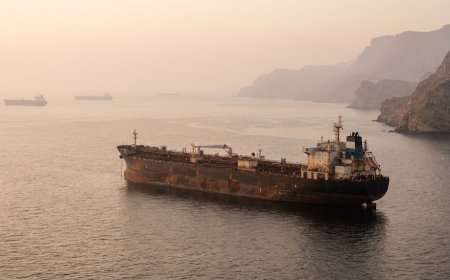
Iran's Islamic Revolutionary Guard Corps said two supertankers sailing a southern route near the Strait of Hormuz that Tehran has not sanctioned struck naval mines, leaving both ships disabled. The claim, carried by the state news agency IRNA on Oct. 23, came as Brent crude jumped above $116 a barrel and the United Arab Emirates reported a tanker oil spill washing onto its shoreline.
"Both vessels struck a naval mine," the IRGC navy said, adding that the resulting blasts and fires meant "their engine rooms were disabled, leaving them stranded in place." The force did not name the tankers, their flags or their owners, and none of the reports reviewed by Eurasian Post carried independent confirmation of the incident.
Guards say 'violating' traffic has stopped
The Fars news agency, quoting an IRGC source it did not name, reported that ships the Guards regard as violators have stopped moving through the strait. According to that account, three oil tankers were hit on Thursday, navigation equipment aboard offending vessels was destroyed and one more ship was destroyed that night. The source warned that Iran's reaction would be "far more forceful" if what it called oil smuggling resumed.
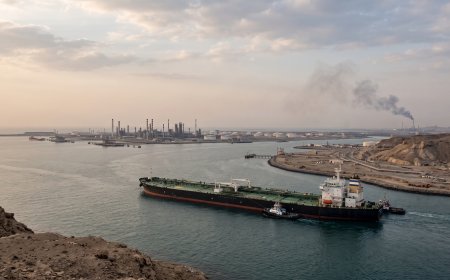
The IRGC has said it goes after tankers that use a southern lane close to the Omani coast without Tehran's permission, Euronews reported. The broadcaster noted that Iran holds no recognized authority under international maritime law, including the UN Convention on the Law of the Sea, to restrict passage through the strait. Both Tehran and Washington have imposed blockades in the waterway since the war began in late February with U.S.-Israeli strikes on Iran.
Oil on UAE shores
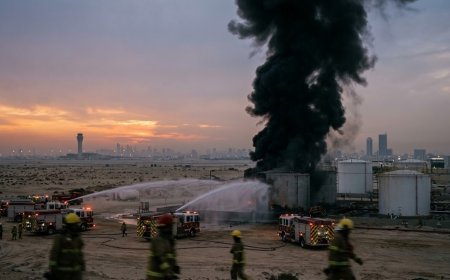
On Friday, the UAE's Ministry of Climate Change and Environment said it had "detected a tanker oil spill affecting Umm Al Quwain's beaches." The beaches were closed, and the ministry said its teams had moved at once to contain and cordon off the oil and begin cleanup. It did not identify the vessel responsible. The UAE lies roughly 40 to 50 nautical miles from the narrowest point of the strait, according to Euronews.
Merchant ships in Gulf waters have come under repeated attack during the conflict, with strikes concentrated near Hormuz in recent weeks. On Oct. 9, the UK Maritime Trade Operations agency reported that a projectile hit a vessel off the UAE coast and set off a fire that crews later controlled. Maritime security company Vanguard identified that ship as the Panamanian-flagged tanker GEM NO.2.
Markets price the risk
Brent crude climbed 3.1% to $116.72 a barrel on Friday, while the U.S. benchmark West Texas Intermediate gained 3.8% to $103.27, according to an AFP market report published by France 24. Before the war, about one-fifth of the world's oil moved through Hormuz, Euronews reported. The AFP report linked the day's gains to the wider Middle East conflict rather than to any single incident.
What it means: If the IRGC account holds, Iran has shifted from threatening the strait to enforcing its own lane rules with mines, a weapon that cannot tell one ship owner from another and can remain a hazard long after any political settlement. The claim remains unconfirmed, but it lands in a market already pricing in sustained disruption, with Brent above $116 a barrel. The Umm Al Quwain spill adds an environmental bill that lands on a Gulf state outside the fighting. For Eurasian oil producers, higher prices mean extra revenue, but for importers already absorbing record EU pump prices tied to Hormuz, each new incident strengthens the case for Caspian and overland supply routes that avoid the Gulf entirely.
What's Your Reaction?
 Like
0
 Dislike
0
 Love
0
 Funny
0
 Wow
0
 Sad
0
 Angry
0









Comments (0)