

India poll body defends draft voter roll removals as critics say Muslims bear the brunt
Poll body says 130 million draft flags are dead, shifted or duplicate voters; critics cite West Bengal data showing Muslims hit hardest.

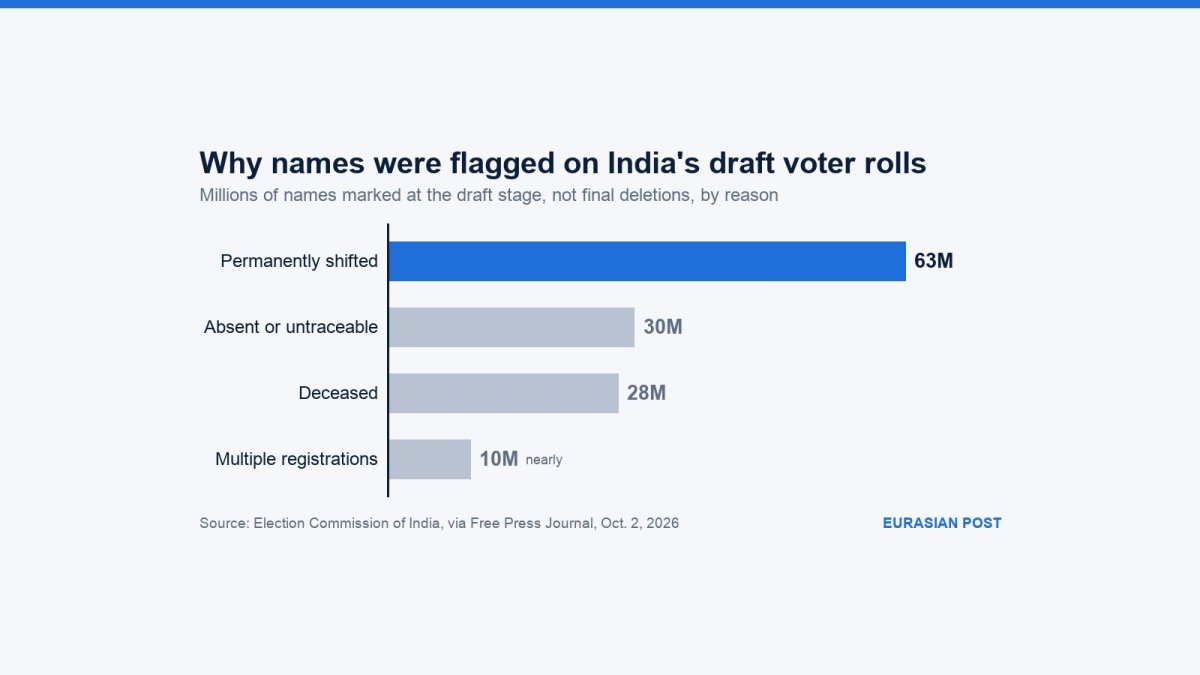
India's Election Commission is defending a nationwide revision of voter rolls that flagged about 130 million names at the draft stage, while opposition parties, academics and protesters in New Delhi say Muslims have borne a disproportionate share of the removals.
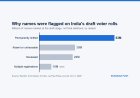
The exercise, known as the Special Intensive Revision, or SIR, began on June 24, 2025. The Election Commission of India (ECI) says the figure of 13 crore, or 130 million, covers electors marked as absent, shifted, dead or duplicate in the draft rolls and does not represent deletions from the final rolls, the Free Press Journal reported on Oct. 2. By the commission's count, about 28 million of those voters had died, 30 million were absent or could not be traced, 63 million had moved permanently and nearly 10 million were registered in more than one place.
West Bengal figures at the center of the dispute
Critics point to West Bengal. Of 2.75 million names on the state's published removal list, about 1.8 million, or around 70%, belong to Muslims, who make up roughly a quarter of the state's electorate, Middle East Eye reported on Oct. 23, citing the news site The Wire. In some districts, Muslims accounted for more than 90% of removals, according to The Wire's figures. The outlet also reported that Dalits were among the communities most affected.
"An overwhelming majority of the deleted votes are those of Muslims," Ajay Gudavarthy, an associate professor at Jawaharlal Nehru University, told Middle East Eye. He argued that the system could be made accountable "only through mass protests and institutional decentralisation." Sameen Ud Din, a businessman in Old Delhi, said: "It is an irony not to find my name in the SIR list." In Odisha, resident Sayed Rashad Ikmal described the threat of being sent to Bangladesh as among "the most intimidating narratives directed at Muslims."
The commission's response
The ECI says the revision is designed to remove dead, duplicate and ineligible voters. It has rejected allegations of "vote chori," or vote theft, calling them part of a misleading narrative, and points to door-to-door checks by Booth Level Officers, scrutiny by political parties' booth agents and provisions for appeal, according to the Free Press Journal's Oct. 2 report. Eligible voters can file claims and objections before final rolls are prepared; in Maharashtra, the disposal of notices and objections is scheduled to finish by Nov. 10. The commission also says about 23.7 million voters aged 18 to 28 have been added since the revision began.
The commission's internal process has also come under scrutiny. The Indian Express reported that Election Commissioners Sukhbir Singh Sandhu and Vivek Joshi formally objected at least 14 times in 10 months, Middle East Eye said. The ECI described those notes as suggestions and said its decisions were unanimous; the Free Press Journal reported that every SIR decision was taken unanimously by the three-member commission.
Protests and restrictions in Delhi
Opposition to the revision has moved onto the capital's streets. The Indian National Congress estimated that 250,000 people joined a rally in Delhi in mid-October. On Oct. 12, Delhi Police removed Jantar Mantar, the city's long-standing protest venue, from its list of approved protest sites, and authorities barred gatherings of four or more people in some areas and detained protesters, Middle East Eye reported. "Our demand is clear: roll back the SIR because it is a state tool to change the country's voting demographics," said a protester identified as Vishnu.
What it means: With India's next general election due in 2029, the revision is turning a routine administrative task into a contest over the boundaries of the electorate. The commission's defense rests on the gap between draft markings and final deletions, so the claims-and-objections window, not the headline figure, will determine how many people actually lose their vote. If eligible voters in West Bengal and other states with large Muslim populations are restored at the same pace as everyone else, the ECI will have a stronger case that it cleaned the rolls rather than reshaped them; if they lag, the accusations of bias will harden. The restrictions on protest in Delhi suggest the dispute will stay a political flashpoint long before the final rolls are published.
What's Your Reaction?
 Like
0
 Dislike
0
 Love
0
 Funny
0
 Wow
0
 Sad
0
 Angry
0







Comments (0)