

Indian envoy says Putin and Modi ordered ministries to widen trade push
Ambassador Vinay Kumar told TASS the leaders tasked their governments after the BRICS summit, as first-half trade reached $38 billion.

Russian President Vladimir Putin and Indian Prime Minister Narendra Modi instructed their governments to expand bilateral cooperation after the BRICS summit, India's ambassador to Russia, Vinay Kumar, said in remarks published by Russian state news agency TASS on Oct. 24.
Kumar said the two leaders agreed to "give instructions to the relevant ministries and agencies on further developing cooperation," with their discussions covering the full range of Russian-Indian relations, including trade and commerce. TASS, which described itself as an information partner of the second Russian-Indian business forum, called Time, reported the comments.
From the BRICS stage to Kazan
According to the ambassador, Putin and Modi took part together in the BRICS business summit and toured the Innoprom India industrial fair in New Delhi, which Kumar described as "the first Russian industrial exhibition held in New Delhi." The Time forum then met in Kazan on Oct. 15-16 to push trade and economic ties forward.
Separately, the news site Russia's Pivot to Asia reported that bilateral trade reached $38 billion in the first six months of 2026, citing remarks in Kazan on Oct. 15, and that the two countries see themselves on course for the $100 billion target set for 2030 during Modi's July 2024 visit to Moscow. TASS did not report trade figures in its account of the ambassador's comments.
Sberbank data cited by the same outlet put trade for January through July at $47.7 billion, up 24.3% from a year earlier. India's purchases made up $44.9 billion of that, including $36 billion of crude oil, against Indian exports of just $2.8 billion.
A lopsided ledger
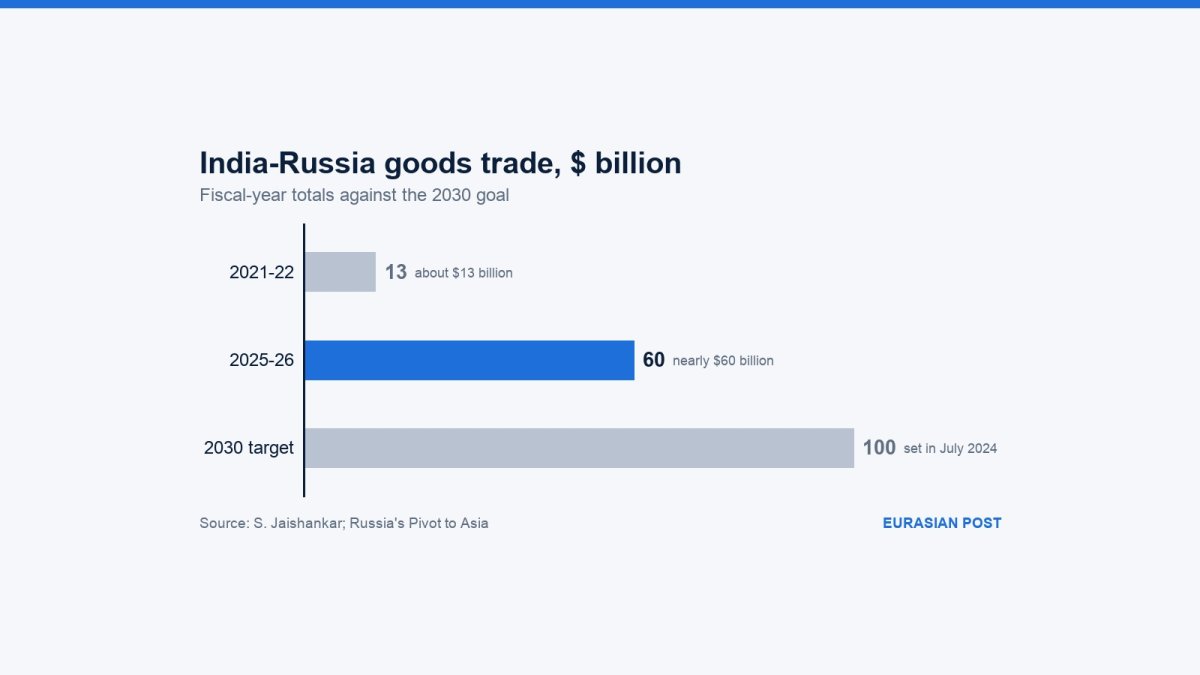
The imbalance has grown with volume. Indian Foreign Minister S. Jaishankar said in August that goods trade had risen from about $13 billion in 2021-22 to nearly $60 billion in 2025-26, as India bought large amounts of Russian oil amid disruption in the Middle East.
According to the same outlet, India sources energy and fertilizers from Russia while selling pharmaceuticals and widening openings for skilled workers. The two sides are negotiating a bilateral investment treaty and strengthening payment channels in national currencies, and India has opened free trade talks with the Russia-led Eurasian Economic Union.
The talks unfold after U.S. President Donald Trump signed the Graham Act, arming a tariff threat against buyers of Russian oil.
What it means
The leaders' instructions are an attempt to turn an oil-driven surge into a broader economic relationship before the imbalance becomes a political liability for New Delhi. With Indian exports a small fraction of imports, the investment treaty, local-currency settlement and a trade deal with the Eurasian Economic Union are the tools that would let India sell more into Russia and settle more of the trade in national currencies. Whether the $100 billion goal is reached by 2030 will depend less on crude volumes than on how quickly those mechanisms move from negotiation to use, and on how much secondary-sanctions pressure New Delhi is willing to absorb.
What's Your Reaction?
 Like
0
 Dislike
0
 Love
0
 Funny
0
 Wow
0
 Sad
0
 Angry
0









Comments (0)